Showing posts with label sin. Show all posts

Thursday, February 22, 2018

Bearing with Us


And the bow shall be in the cloud; and I will look upon it, that I may remember the everlasting covenant between God and every living creature of all flesh that is upon the earth."
Genesis 9:16


My uncle told me recently that he’s in the market for an alternator—or maybe it was a fuel pump or a carburetor.  I’m not so good with that sort of thing.  He’s been scanning eBay and reading collectors’ magazines, because you can’t just call up NAPA to ask them to order you one. 

He’s restoring his grandfather’s 1947 Packard, and the old one has given way.  It’s at least the second time he’s had to overhaul with that old car, and he said he’s wondering if it’s really worth all the fuss.  It’s not quite old enough to be valuable, and it really isn’t all that stunning, the chariot of a second-rate insurance salesman.  It’s never been all that reliable, and I think you can guess what the gas mileage is like. 

Tuesday, July 11, 2017

Wretched man that I am

“Wretched man that I am! Who will deliver me from this body of death?  Thanks be to God through Jesus Christ our Lord!”  Romans 7:24-25

The Mrs. Piggle-Wiggle stories are favorites on our boys’ bookshelves.  They are set in a pleasant suburb in the mid-fifties, the sort of place where mothers have always just taken sugar cookies out of the oven and daddies are headed out after work to finish the new treehouse ladder.  The stories are populated with children—accomplished, good natured, obedient children—who just happen to be passing through unfortunate phases.

Take Nicholas Semicolon, subject of the story Philip read to all of us as we made our way across Maine last week.  Nicholas is ten, large and strong for his age, the apple of his mother’s eye.  But he also happens to have become a thoroughly rotten bully.  He hits girls and pulls dog’s tails, upsets baby carriages and speaks rudely to everyone he meets.  His parents have been blissfully ignorant about all of this until they receive a call from Mrs. Eager, whose son’s legs are covered in bandages after little Nicky’s latest attack.

Friday, January 20, 2017

Behold the Lamb

“The next day he saw Jesus coming toward him, and said, "Behold, the Lamb of God, who takes away the sin of the world!”  St. John 1:29

I wonder if you have chosen your seat in church for a particular reason.  A few years ago, one of my parishioners told me that she had thought a good deal about it before settling on her choice. A dear friend, a rather holy woman, had once sat week by week in the pew in front of her.  She didn’t really hear that well, so being nearer the pulpit was useful.  But really, she chose the pew because it had the best angle for viewing both her favorite stained glass window and the Altar Cross. Seeing both those things allowed her to concentrate her mind when she prayed and helped her to feel that God was near.

I could understand just what she meant, because I too had a favorite seat, the rector’s stall at Saint Paul’s Church in Sharpsburg.  Because there I had a perfect view of the Lamb.  There was a tiny window in the wall of the chancel just opposite the rector’s pew, a lamb with a halo, bearing the flag of victory.  Jesus, the Lamb of God who takes away the sin of the world.  No one could see it but me, but I saw it constantly, as I sat and listened to the readings, as I turned to the people to pronounce the Word of Absolution or to approach the pulpit to preach, as I turned to the Altar to pray.

Thursday, January 12, 2017

Ponder: "Lo,' he said, 'the lamb; there is no longer need of the goat."

Now the the garment of mourning is rent; we have put on the white robe
Which the spirit has woven for us from the lamb’s fleece of our Lamb and our God;
Sin is taken away, and immortality is given us, our restoration is clear.
The Forerunner has proclaimed it.…
O, the message of the Baptist, and the mystery in it!
He calls the shepherd lamb, and not only a lamb, but one to free from mistakes.
He showed the lawless that the goat which they sent into the desert was ineffective.
“Lo,” he said, “the lamb; there is no longer need of the goat;
Put your hands on him,
All of you who confess your sins,
For He has come to take them away, those of the people, and of the whole world.
For lo, the One whom the Father has sent to us is the One who carries away evil,
Who appeared and illumined all things.”
Romanus Melodius, Kontakion for Epiphany.

Friday, December 30, 2016

God's Peculiar People: A Christmas Sermon

“He gave himself for us, that he might redeem us from all iniquity,and purify unto himself a peculiar people.”  Titus 2:14

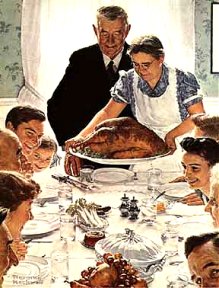
Christmas is our American family holiday.  Or maybe better, it’s the holiday when we all aim to cobble together, if only for a few candlelit hours, the version of family we would really like to be.  Expectations are ratcheted up by Norman Rockwell paintings, sentimental holiday movies, and “There’s No Place Like Home for the Holidays,” and most of our families have at least one special “holiday person,” who seems to live for the thrill of whipping the whole spectacle into shape each year. 

Most families have Christmas rituals, even if they aren’t otherwise all that ritualistic.  There’s a certain way we open gifts.  Decorations go in certain places.  The main meal is always served at the same time (and we simply can’t imagine how anyone would do it another way).  A few of you may have ended up here this evening for reasons that run along these same lines. 

Wednesday, September 21, 2016

Ponder: "the threat is to our souls"

“I cut my daily silences from one hour to 25 minutes; and then, almost a year later, to every other day. I knew this was fatal — that the key to gaining sustainable composure from meditation was rigorous discipline and practice, every day, whether you felt like it or not, whether it felt as if it were working or not. Like weekly Mass, it is the routine that gradually creates a space that lets your life breathe. But the world I rejoined seemed to conspire to take that space away from me. “I do what I hate,” as the oldest son says in Terrence Malick’s haunting Tree of Life.

I haven’t given up, even as, each day, at various moments, I find myself giving in. There are books to be read; landscapes to be walked; friends to be with; life to be fully lived. And I realize that this is, in some ways, just another tale in the vast book of human frailty. But this new epidemic of distraction is our civilization’s specific weakness. And its threat is not so much to our minds, even as they shape-shift under the pressure. The threat is to our souls. At this rate, if the noise does not relent, we might even forget we have any.”


Andrew Sullivan, “I Used to Be a Human Being.”  New York Magazine.  20 Sep. 2016

Tuesday, September 6, 2016

Comfort and the Cross

“Whoever does not carry the cross and follow me cannot be my disciple.”  St. Luke 14:27

Last Sunday after the 8:00 service, Ralph Tildon came up to me and told me that my sermon had reminded him of a movie.  “We’re No Angels,” was based on the passage about welcoming the stranger that I had taken as my text.  I don’t expect you’ve ever heard of the movie either, as it never broke number 8 in the box office listing when it came out in 1989.  But it was a slow Sunday evening, so Allison and I watched it together. 

The movie tells the story of two bumbling convicts who escaped from a prison and were taken into a monastery, after being mistaken for famous Biblical scholars.  The convicts are played by Sean Penn and Robert DeNiro, and for me it was worth the cost of the rental to see Robert DeNiro trotting around in an old fashioned priest’s cassock and biretta.  The plot plays out as you would expect when two semi-illiterate, chain-smoking cons try to pose as holy men in the midst of a massive manhunt. 

The climax of the film comes when Father Brown, aka Jim the convict, is spontaneously invited to give the sermon at the monastery’s annual festival.  Jim is Sean Penn’s character, a relatively kind hearted fellow who looks about fourteen.  By this point in the movie, you know to wince when he opens his mouth, but you’re also on his side. 

Thursday, August 18, 2016

Ponder: The Debt that Must be Paid

"The loss of joy has many causes, but chief among them is a certain impotence in us, which derives from of our inability to shed the guilt that plagues us, to discharge the debt we bear (whether we know it or not, and we mostly do not) on our hearts, an incapacity that has arisen precisely because we have become too “advanced” in our power and knowledge to know what to do about the hard and immutable truths regarding sin, guilt, and atonement. It is a cruel but common illusion for us to think that joy is our natural state, and automatically results from the banishment of those alien and inhuman concepts of sin and guilt. Something closer to the opposite is true. Sin is the debt that must be paid. Our moral nature demands it. Which is why only the frank and humble acknowledgment of guilt, and a full embrace of the means available for our cleansing of it, can open us to the possibility of joy. That may be the one possibility that our secular age is unprepared, and unwilling, to admit."

Wilfred McClay, "Some Reflections on Joy, Happiness...and Guilt" (2014)

Friday, June 3, 2016

Ponder: "we all share in shattering duality"

“The great mistake, I think, the mistake that surely leads to more misery, is for the victim to succumb to the normal temptation and take the part for the whole.  For there is a balance here: the great majority of those who winked and nudged and raved and joked would, in the very next moment, have willingly given me whatever lift they could, and the same schoolboy who staggered with such derisive exactness would in an instant have given up his free morning to serve my Mass and drive me halfway across the state and back.  We all share in shattering duality—and by this I don’t mean that soggy, superficial split that one so often sees: the kind of thing, for example, where the gangster sobs uncontrollably at an old Shirley Temple movie.  I mean the fundamental schism that Newman referred to when he spoke of man being forever involved in the consequences of some “terrible, aboriginal calamity;” every day in every man there is this warfare of the parts.  And while all this results in meanness and bitterness and savagery enough, God knows, and while only a fool can look around him and smile serenely in unwatered optimism, nevertheless  the wonder of it all is to me the frequency with which kindness, the essential goodness of man does break through, and as one who has received his full measure of that goodness, I can say that for me, at least, it is in the long succession of these small, redemptive instants, just as much as in the magnificence of heroes, that the meaning and the glory of man is revealed.”


Edwin O’Connor, The Edge of Sadness

Tuesday, March 8, 2016

Ponder: "inexorably to the cross"

From then on, the direction of Lenten energy leads compellingly and inexorably to the cross, and what God accomplished there for all humankind. It’s not that our own individual selves and our own individual sins no longer matter: they matter immensely. They merely pale in significance alongside that which is their antidote, their remedy. As we move through Lent, the theme becomes “less of me and more of Jesus, less of me and more of us.” “We adore you, O Christ, and we bless you, because by your holy cross you have redeemed the world.”  This is in itself a school of holiness, a preparation for our eschatological destiny.

 Dan Martins, "The Morphology of Lent.Covenant 4 Mar 2016

Tuesday, December 29, 2015

Happy Infant, Early Blest

We have escaped like a bird from the snare of the fowlers; the snare is broken, and we have escaped.”  Psalm 124:7

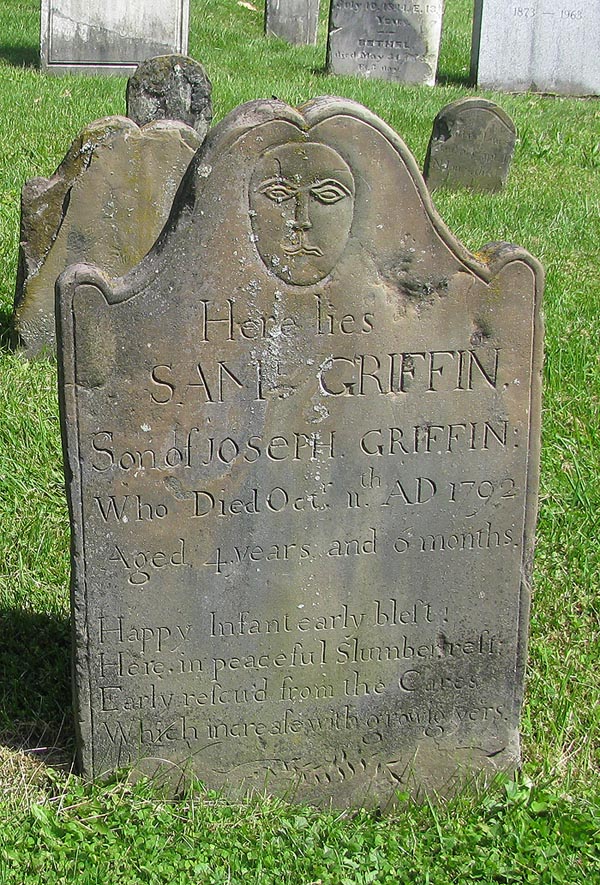
A few yards from the door of this chapel lies the grave of Samuel Griffin, the first person to be buried on this spot.  He died on October 11, 1792, accidentally drowned in the lake at the age of four years, six months.  On his stone, you can still barely pick out the epitaph verses:
            Happy infant, early blest
            Here in peaceful slumber rest
            Early rescu’d from the cares
            Which increase with growing years.

Now, I don’t know about you, but I find that epitaph hard to swallow.  It’s hard for me to imagine those as the words chosen by his mother, the ones that seemed to fit best as she held him dripping and cold in her lap at the shore of the lake. 

I guess it just sounds too easy.  Killed tragically while still a young boy, his whole life ahead of him—is that “happy infant, early blest.”  I’m sure they tried their best, but no one could save him, he had to die in such a frightening way—is that really “early rescued from the cares?”  Surely these words would speak only to someone who wasn’t ready to be honest about the real devastation of such a death—surely they’re trying to put a bright face on things when everything is falling apart inside?  

Saturday, December 19, 2015

O Key of David

O Key of David and Sceptre of the house of Israel, Who dost open and no man doth shut, Who dost shut and no man doth open, come and bring forth from his prisonhouse the captive that sitteth in darkness and in the shadow of death.

He would turn up for the grand occasions in the Chapel when I was a student at Duke.  He was an old man, very distinguished with a craggy face, an emeritus professor of chemistry.  His doctoral robe was Harvard Crimson, and he wore a velvet cap.  And he carried an enormous jeweled staff, with a wide silver head, the mace of the University.  His title was the University Marshall, and that staff represented, I think, the teaching authority.  He bore on behalf of the faculty, who had chosen them to represent him.  When he carried it in on Matriculation Ceremony, or on Founders’ Day or for Baccalaureate, and laid it upon the Altar, it announced to all of us that the university could now get about its business, that the teachers would teach, that students could learn.  He walked very slowly, because he knew that everyone had to wait for him.  His mace was the key that opened the proceedings of a great university.

Tuesday, December 1, 2015

For Meditation: Something Flesh and Blood

"After resisting a potentially lethal drink, Beckel sat weeping on a rock in the middle of a field.  "And I knew," he writes, there was a force that had wanted me not to do that, a force that loved me enough to stop me in my tracks and redirect my steps.  That loved me?  Me?  If there is one moment I can point to, a moment when the idea of God's grace shifted from being some kind of abstract concept to being something flesh and blood, something meaty and rich, something real, that was it."

Conversion, in the Christian tradition, requires the recognition of sin and failure, which is the only way the offer of grace makes sense.  This, to be honest, is a difficult concept for many of us to accept.  But voices as diverse as Carson and Beckel promise something encouraging: that any moment, early or late, can mark the beginning of hope."

Michael Gerson, "When Hope Begins," The Washington Post 1 Dec 2015, A15.

Monday, November 30, 2015

"Good Lord Deliver Us:" The Blessings of the Great Litany

Originally published in The Living Church, 22 Mar. 2015.

Just after the Twin Towers fell on September 11, 2001, the students and faculty at General Seminary in Manhattan gathered in the chapel. The seminary is less than a ten-minute drive north of Ground Zero, and for the students and faculty it was a moment of great confusion, anxiety, and fear. The Rev. Teresa Daniely, now an Episcopal priest, was in her first week of studies at General that day. “I did not know if I would live through that day; I assumed that I would not,” she wrote in 2010 for the Grace Prayer Network’s weblog (is.gd/U77vAr). “We got on our knees and prayed the Great Litany, a series of prayers that includes prayers of confession and prayers in preparation for death.

On that day, when the world seemed to be falling apart, the people of General Seminary found in the Litany the only fitting words for their deepest anxiety and hope. They were in good company. The Litany is a text forged out of tragedy. The eruptions of fourth-century volcanoes, the perils of the Black Death, and wars of the 16th century all left a mark on its historical development. It is a text that speaks to pastoral need, the Church’s gift for times of crisis. When you do not know how else to pray, there is always the Litany.

Sunday, November 8, 2015

We Have Failed, But He Has Triumphed

“He has appeared once for all at the end of the age to remove sin by the sacrifice of himself.”
Hebrews 9:26

Yesterday, the government of Singapore hosted a historic meeting between Xi Jinping, the president of Mainland China and Ma Ying-jeo, the president of Taiwan.  Technically, China and Taiwan are still engaged in a civil war, and it was the first meeting between the leaders of the countries in sixty years.  Many people are hoping for reconciliation.  China and Taiwan share a common language, history and culture.  Both are important economic powers, and there would be advantages in trade and security cooperation.

But with a bloody war and decades of hostile rhetoric behind them, it’s almost impossible for the leaders to know how to speak with each other.  They agreed not to call one another president, because that would suggest that both lead legitimate governments.  No flags can be displayed.  Neither president has the freedom to promise another meeting or to make substantial proposals for common action.  The words they do use must be chosen with extreme delicacy, because anything either leader says could call up old associations and deeply offend the other, perhaps touching off internal scandals that would only make things worse.  In its impotency, its nervous gesturing, what it most reveals is just how far off the goal of normalized relations really lies. 

Sunday, October 25, 2015

Jesus Holds the Scales

“If the offender refuses to listen even to the church, let such a one be to you as a Gentile and a tax collector.” St. Matthew 18:17

There is very little direct teaching in the Gospels about the church and its life. What there is, though, is found in Jesus’ discussion with his disciples in the central chapters of Saint Matthew’s Gospel, from which this evening’s lesson is taking.  These chapters have come to take on a kind of special importance, especially among Christians who try to base everything the church does on a literal interpretation of the Bible.

For example, this three step process that Jesus describes for dealing with a member of the church who sins against another has been treated by some as judicial proceeding. First, confront the person with the sin. Then bring some witnesses. Then present the person for judgment before the entire congregation. One commentator[1] compared it to reading someone his Miranda rights—did you “Matthew 18 him?” one Christian might ask another in talking about how an inter-church controversy unfolded.

Sunday, October 4, 2015

We See Jesus-A Sermon for Pentecost XIX

“As it is, we do not yet see everything in subjection to him.  But we see Jesus.”
Hebrews 2:8-9

It’s been a heavy week, hasn’t it?  The Russians have launched extensive bombing raids in Syria, massively escalating the civil war, with numerous civilian casualties expected.  News continues to surface about the extent of Volkswagen’s emissions switch scandal, with maybe more than 11 million cars effected worldwide.  Several drug companies have admitted to massive price gouging, with one pill used to treat cancer and AIDS patients rising from $13 to $750 per dose. 

And of course, there was another mass shooting, this time at a community college in Oregon, the 294th shooting this year.   It was a shooting in the kind of place where things like that don’t happen, except there aren’t any places like that any more.  We don’t know all the details yet, but eyewitnesses reported that events unfolded in a distinctive way.  The shooter stormed into the classroom with an agenda.  He wanted to know who was a Christian.  And our brothers and sisters who stood firm and confessed our faith, those who claimed to be one of us, he shot them point blank. 

“As it is, we do not yet see everything in subjection to him.”  We believe of course, that the Bible is God’s Word to us, but if we’re honest, it sometimes seems like a word from long ago and far away.  But not this week.  Not this word. 

Friday, May 22, 2015

For Meditation: There and then this Lamb shall mary me

From my morning reading, John Donne's sermon preached at St. Clement Danes (May 30, 1621).  The sermon was delivered at a wedding, and in this section Donne considers the marriage between Christ and each member of His Body.  This passage imagines that, as in the Church's marriage liturgy, there might be a moment in the contracting of the spiritual bond in which others might justly object.

"This is a mariage in that great and glorious Congregation, where all my sins shall be laid open to the eye of all the world, where all the blessed Virgins shall see all my uncleannesse, and all the Martyrs see all my tergiversations, and all the Confessors see all my double dealings in Gods cause; where Abraham shall see my faithlessnesse in Gods promises; and Job my impatience in Gods corrections; and Lazarus my hardness of heart in distributing Gods blessings to the poore; and those Virgins, and Martyrs, and Confessors, and Abraham, and Job, and Lazarus, and all that Congregation, shall look upon the Lamb and upon me, and upon one another, as though they would all forbid those banes, and say to one another, Will this Lamb have any thing to doe with this soule? and yet there and then this Lamb shall mary me, and mary me In aeternum, for ever, which is our last circumstance"  (82-83).

Wednesday, May 6, 2015

For Meditation: "It cannot be attuned and untuned at once"

From my morning reading, Hughson's With Christ in God.

"In sin, man casts out grace, deadens his own ear until God's voice sounds fainter and fainter, and comes seldomer, and at last there follows the stillness of death.  It is heard no more.  God leaves the soul, and it is dead.  Every wilful sin is a part of this deadening of the soul.  Ye cannot wilfully refuse to hear in one way or at one time, and hear at another.  Ye cannot stop your ears to part of God's message, hear and not hear at will.  The soul is a beautiful instrument, attuned by the hand of God, and breathed in by His Holy Spirit.  It cannot be attuned and untuned at once.  It cannot yield at once the harmony of heaven and the jarring discords of the world."  Edward Pusey, 208.

Monday, April 27, 2015

For Meditation: God's love and our sin

From my morning reading, Hughson's "With Christ in God"

Man's reaction to his own sin is to flee from God in fear; God's reaction to man's sin is to draw near to man in love,  The more we sin, the more do we need His love, and the more generously is that love offered to us.  The vivid illustration of this is found in our Lord's first Word on the cross.  "Then said Jesus, Father, forgive them; for they know not what they do."  The verb said is given in a form which implies continued action: "He kept on saying."  As their blasphemies and mockings increased, He increased His cry that they might be forgiven.  He would not let their sin outdistance His love.  And so has He ever been.  So will He ever be.  (p. 33-34).