“I bear on my body the marks of Jesus.” Galatians 6:17
Like a number of you, Allison and I have been watching the recent Ken Burns series about the Vietnam War. Like so many of his other documentaries, it carefully weaves together the story of that troubled era, placing each major leader and event in its proper place. It also has that human touch that marks Burns’ storytelling, breaking the wide narrative to focus on the experiences of ordinary people who patrolled the jungles, marched in protest and captured it all behind the lens of a camera.
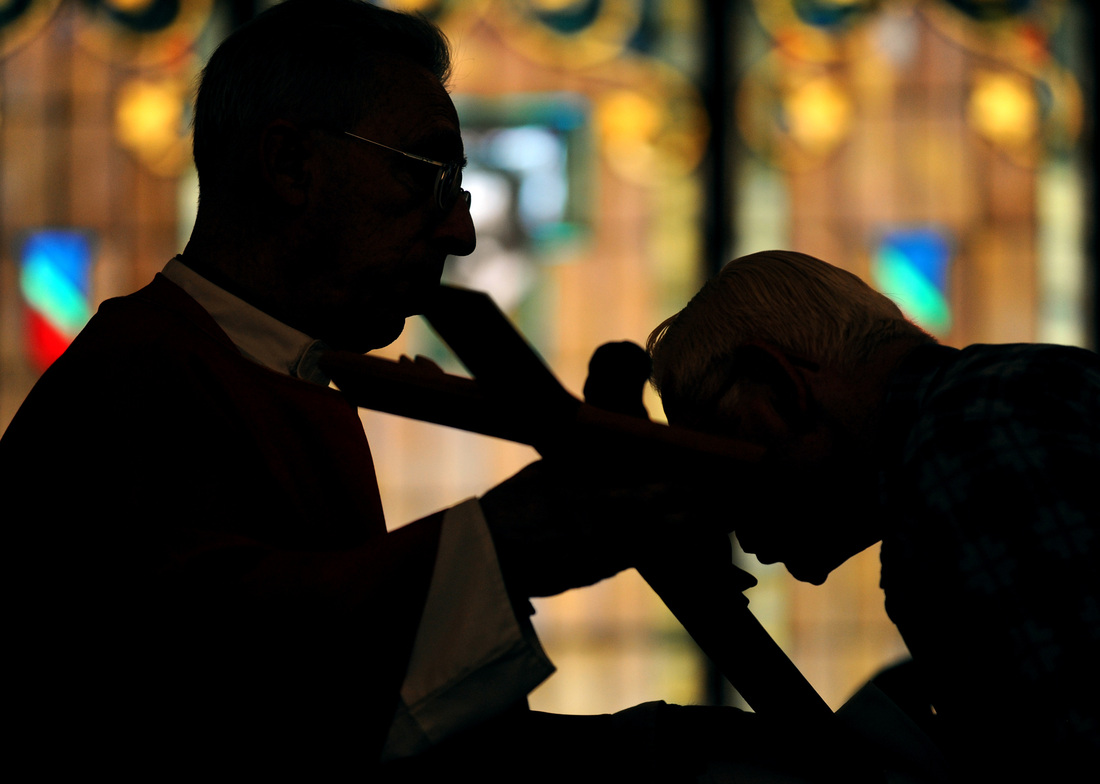
In his Civil War epic, Burns was restricted to diaries and letters, but for this series, he and his crew interviewed dozens of people, American and Vietnamese, about what they had seen and felt. It was striking how vividly these men and women could recall the events of a half century ago: the sounds of exploding shells, the feel of boots sloughing through the rice paddies. Several of them pulled up a pantleg or unbuttoned a shirt to reveal the traces of old wounds. I can remember that day because I see it every day. I am marked forever.
My mind goes immediately to King Henry’s words in the English camp before the Battle of Agincourt:
He that shall live this day, and see old age,
Will yearly on the vigil feast his neighbours,
And say 'To-morrow is Saint Crispian:'
Then will he strip his sleeve and show his scars.
And say 'These wounds I had on Crispin's day.'
Musings about the spiritual life and the mission of the Church by an Episcopal parish priest.
Showing posts with label Cross. Show all posts
Tuesday, October 10, 2017
Thursday, April 13, 2017
It Would Have Been Enough
“Having loved his own who were in the world, he loved them to the
end.” St. John 13:1
Maybe you saw the article
in the Washington Post last week about matzoh man’s visit to Farragut Park[1]. Maybe, at least, you remember the
unforgettable picture. Matzoh Man is a
rabbi, Shmuel Herzfeld of Synagouge Ohev Sholom in Northwest. About this time every year he dresses in his
matzoh suit and kippah, which are white with brown spots. He revs up the matzoh mobile, a Crown Vic
wrapped in a vinyl coating that makes it look like the ubiquitous Jewish
cracker.
And he drives downtown to
pass out boxes of the unleavened bread, all the while wishing people a happy
Passover and reminding Jews to keep the Seder at home this year. He’s ready to give you the matzoh you need,
to invite you to the community seder at his synagogue, to do everything he can
to awaken the consciousness of America’s increasingly secular Jews to remember
their ancient traditions and to celebrate God’s faithfulness once more this
year.
The Post reporter, who
was obviously having a great time with the article, asked rabbi Herzfeld why he
does it. And as I was reading, I thought
to myself: “this guy is going to say he was a performance artist in his former
life, or that he finished last in the rabbinical council’s fantasy football
pool.” Why else would a well-educated,
successful religious leader go downtown dressed like a Saltine to shame his
fellow Jews into keeping the Seder.
Wednesday, April 12, 2017
Homage for Our True King
From the Sounds of St. Francis, 13 April 2017
I know that several of
you, like me, enjoyed watching the recent Netflix miniseries, The Crown. For me, one of the most moving scenes was
Elizabeth’s coronation in Westminster Abbey at the close of the fifth episode,
an event whose planning had consumed a good deal of the dramatic tension in the
several episodes preceding it. The
Netflix series faithfully rendered the grand music, solemn ritual and stunning
costumes of the ceremony.
It also showed part of
the homage, the ancient ceremony that
follows the anointing and crowning of the monarch. The senior nobles of the kingdom, the “lords
of the realm,” (Prince Philip notably among them) knelt before the new queen to
speak an oath and kiss her hand. The
words of the oath at the homage (not includes in the series script, if I
remember correctly), are these: “I do become your liege man of life and limb,
and of earthly worship; and faith and truth I will bear unto you, to live and
die, against all manner of folks. So
help me God.”
The oath is a promise of deep
loyalty. The act of kneeling expresses
respect, even a kind of reverence for the monarchy and its place in the life of
the nation. And the kiss is a token of
affection, a sign that the promise is made freely, with the whole heart.
Tuesday, March 28, 2017
Ponder: "he meant to give copious redemption"
“[Thomas Aquinas] says
that the very least one of these sufferings was of itself suffering enough to
redeem the human race from all sin (that is woven into the Adoro Te). But, says St.
Thomas, it was fitting that He should have to endure all at once. One suffering would have sufficed for our
Redemption, but it would not suffice for the Love of the Redeemer. He meant to give copious Redemption. He willed that the beaker should brim
over. He gave a thousand Redemptions all
in one.”
Vincent McNabb, OP, The Craft of Suffering (1936), 79.
Tuesday, March 21, 2017
Ponder: "the means whereby we enter into its bounty"
“Traherne’s devotion to
the cross sprang from seeing it the final proof of the nature of God, a nature
which had been indicated in all the Divine actions wherever we may look, in the
world around us, into our own best thoughts, into the history of man’s
redemption, everywhere is to be seen an ever-broadening stream of love. The cross is both the demonstration of that
love and the means whereby we enter into its bounty. Traherne’s eyes are not fixed upon the
damnation from which the passion of Christ saves mankind, but on the felicity
into which it admits us. We learn to
prize our own nature by thus seeing the value that God sets upon it. So our deepest repentance must be for having
failed to love and our prayer that we may love more fully.”
C. J. Stranks, Anglican Devotion, 105-6.
Saturday, March 18, 2017
Praying the Passion with St. Bridget: A Holy Dying
Then
Jesus, crying with a loud voice, said, “Father, into thy hands I commit my
spirit!” And having said this he breathed his last. St. Luke 23:46
Several of the Fifteen Os also make
mention of a particular aspect of discipleship that was especially important in
St. Bridget’s time, ending life in faith and trust, having what Jeremy Taylor
famously described as “a holy dying.” As
she meditates upon the end of Jesus’ life, St. Bridget is also inviting us, as
does the final stanza of one of the Victorian passion hymns, to “Learn of Jesus
Christ to die[1]”
In her concern with a holy death, in part St.
Bridget reflects the reality of her times.
She was surrounded by people, all of them baptized Christians, who died
in unexpected ways every day. An
epidemic struck a village, an army laid siege to a town, a fire swept through a
city, and thousands would die. People
lived perilous lives, and unlike the reality in the Western world today, there
were very few means of effectively blunting the pain, so that most people were
conscious and fully aware of death’s approach.
Praying the Passion with St. Bridget: Call to Mind
We
know that our old self was crucified with him so that the sinful body might be
destroyed, and we might no longer be enslaved to sin. Romans 6:6
In my last meditation, I spoke about the
way in which Bridget’s passion prayers carefully turn us away from the danger
of viewing Christ’s passion and death as a purely human story. They also, quite carefully steer us away from
the accompanying danger of seeing the Cross as an event that belongs only to
the past, something that happened on a lonely hill in Palestine long ago and
remains there, an interesting story in someone else’s life.
Instead Bridget believes that Christ’s
passion and death are a reality with deep significance for the present moment,
and that Christian discipleship is deeply bound up in responding to Christ’s
call, described in one of the prayers as “enduring in the way of the Cross.”
Praying the Passion with St. Bridget: Devastating and Glorious
God
was in Christ, reconciling the world unto himself, not imputing their
trespasses unto them; and hath committed unto us the word of
reconciliation. II Cor. 5:19
If you’ve ever read through one of the
Gospels from beginning to end in a single setting, maybe what surprised you
most was how long the passion story, the account of Jesus’ suffering and death
is. In what is probably the earliest
Gospel, St. Mark, 45% of the text is of the last week of Jesus’ life. Regular worshippers know to prepare
themselves for Palm Sunday, because when we read the passion, it will take
quite a long time.
The Gospels are unlike any other kind of
literature that predates them in the way they focus in on this final (or
properly almost final) part of the
life of their subject. We have some
deathbed scenes for other important figures in the Bible, and the classical
biographies usually include an account of the death. There is generally in
ancient literature a sense that the death reveals the character, but the
passions of the Gospel stories are really unprecedented.
Praying the Passion with St. Bridget: Weeping with the Pain of the World
“He was wounded for our transgressions, he
was bruised for our iniquities; upon him was the chastisement that made us whole, and with his stripes we are
healed.” Isaiah 53:5
You may think it odd to begin a
presentation about a famous set of prayers by a Swedish nun by spending time
with a German painting. But this
painting was directly inspired by the devotional writings of Bridget of Sweden,
especially her Revelations, a book of
visions of the crucified Christ. Bridget
never saw this painting, as it was completed 130 years after her death. But had she been able to paint, I believe she
would have created something just like this.
This is the Isenheim Altarpiece, painted
by Matthaeus Gruenewald in 1515 for the hospital chapel at Monastery of St.
Anthony in a village near Colmar in Alsace, now a part of France. One of the masters of the Mannerist style,
this is Gruenewald’s greatest work. A
similar “Small Crucifixion” is in the National Gallery.
The monks who served at the monastery of
St. Anthony were a community dedicated to treating those who suffered from the
plague and ergotism. There was no
remedy, and the monks’ mission was to provide physical care and spiritual
consolation. The painting appropriately
reveals Jesus who suffered as we suffer and who shows the extent of God’s love
through offering Himself to destruction.
Jesus is present in our pains and reveals His mercy as we face the
certain prospect of death.
Sunday, January 1, 2017
Circumcised for Us
“And at the end of eight
days, when he was circumcised, he was called Jesus.” St. Luke 2:21
I will never
forget how I came to know all about circumcision. I was in the fourth-grade class at Vacation
Bible School at Saint John’s Church. In
our little town, the ecumenical Bible School was a big deal, and there were
about twenty of us nine-year-olds gathered around tables in a corner of the
Fellowship Hall. Our teacher was Mrs.
Truax, a dignified, silver-haired lady who taught Sunday School at Saint John’s
for a half-century.
We had
memory verses each day at Bible School, and there was a little prize if you
could recite it back the next day. And
that day’s memory verse was from Galatians, “neither circumcision availeth any
thing, nor uncircumcision, but a new creature.[1]” Looking back, it was a rather complicated
text for a nine-year-old, though maybe not so hard to memorize. The thing was, I didn’t know what the text
was talking about. I had some vague
understanding that circumcision was a religious term, like intercession or consecration. This was my chance to get the matter cleared
up.
So, I raised
my hand and asked, “Mrs. Truax, what is circumcision?” And her face blanched and she began looking
around, as if to make sure that none of the other classes had heard. She then ordered all the girls to leave the
room, and then proceeded, in hushed tones, to give us boys who remained behind
a pretty straightforward explanation. It
was by far the most dramatic thing that ever happened in my decade or so of
children’s religious education. And you
can bet that every boy—and every girl, for that matter—who was there never has
forgotten what circumcision is.
Monday, November 14, 2016
Ponder: "it is this only that can make us free"
"They who imagine that self-denial intrenches upon our liberty, do not know that it is this only that can make us free indeed; giving us the victory over ourselves; setting us free from the bondage of our corruption; enabling us to bear afflictions, (which will come one time or other;) to forsee them without amazement; enlightening the mind, sanctifying the will, and making us to slight those baubles which others so eagerly contend for.,,It is the greatest mercy, that God does not consult our inclinations, in laying upon us the Cross, which is the only way to happiness. Jesus Christ crucified would have few imitators, if God did not lay it upon us, by the hands of men, and by His providence."
Thomas Wilson, Sacra Privata.
Monday, September 26, 2016
Ponder: a true pneumatologia crucis
"This is the paradox of divine love, a true pneumatologia crucis. To invoke the Spirit, praying the prayer, 'Come Holy Spirit' is a wonderful, but perhaps also a sombre thing to do. It is wonderful because it asks God to draw us into the same relationship of love that Jesus had with the Father. It is sombre because it is asking God to draw us into the same relationship Jesus had with the world, which led him to a cross."
Graham Tomlin, "The Prodigal Spirit and Church Growth," in Towards a Theology of Church Growth (2015), 135.
Monday, September 19, 2016
Victory is Ours: A Sermon for Holy Cross Day
"The LORD has made known his victory; * his
righteousness has he openly shown in the sight of the nations." Psalm 98:3
As you might
have noticed, just now I made the sign of the Cross over myself. I do it quite often. I sat down and counted this week, and
discovered that in the usual course of celebrating the Eucharist on Sunday, I
make the sign of the Cross not once or five or ten times, but 27 times, as well
as making it over each of you individually with the wafer when you come forward
to receive Holy Communion. Making the
sign of the Cross is a ritual that accompanies many different words and
movements in the course of the liturgy, including nearly all the most important
ones. I use the Cross when I ask God to
be with me in reading and hearing the Gospel, when I speak His word absolving
your sins, when I bless the bread and wine, when I speak His blessing over all
of you at the end of the service, and at quite a few other times besides
these.
And of
course, the Cross isn’t just here among us in the ritual action, we also
worship facing a Cross. The service
begins when the choir and the sacred ministers come in, proceeded by a
Cross—and we brought the beautiful jeweled one out of the vault to mark this
special day. There are crosses on the
windows and the paintings, the arches and the plates. The silver cruets we use at the Altar have
crosses on their tops. My vestments
today are adorned with a half-dozen of them.
There’s one on the steeple, and the whole building, for that matter, is
shaped like a Cross.
Now, if
you’re new here, all these crosses are likely to strike you as rather odd,
maybe as a kind of symbolic overkill.
Surely, we could mix it up a bit, couldn’t we? What is it about the Cross that urges us
Christians to plant it everywhere, to mark everything with it? What does it
mean for us?
Saturday, September 17, 2016
Ponder: "the evil spirit of defeatism"
"While painfully aware of our own frailties, we have to march
on without giving in, keeping in mind what the Lord said to Saint Paul:
"My grace is sufficient for you, for my power is made perfect in weakness'
(2 Cor. 12:9). Christian triumph is
always a cross, yet a cross which is at the same time a victorious banner borne
with aggressive tenderness against the assaults of evil. The evil spirit of defeatism is brother to
the temptation to separate, before its time, the wheat from the weeds; it is
the fruit of an anxious and self-centred lack of trust."
Pope Francis, Evangelii Gaudium, 85.
Tuesday, September 6, 2016
Comfort and the Cross
Last Sunday
after the 8:00 service, Ralph Tildon came up to me and told me that my sermon
had reminded him of a movie. “We’re No
Angels,” was based on the passage about welcoming the stranger that I had taken
as my text. I don’t expect you’ve ever
heard of the movie either, as it never broke number 8 in the box office listing
when it came out in 1989. But it was a
slow Sunday evening, so Allison and I watched it together.
The movie tells
the story of two bumbling convicts who escaped from a prison and were taken
into a monastery, after being mistaken for famous Biblical scholars. The convicts are played by Sean Penn and
Robert DeNiro, and for me it was worth the cost of the rental to see Robert
DeNiro trotting around in an old fashioned priest’s cassock and biretta. The plot plays out as you would expect when
two semi-illiterate, chain-smoking cons try to pose as holy men in the midst of
a massive manhunt.
The climax
of the film comes when Father Brown, aka Jim the convict, is spontaneously
invited to give the sermon at the monastery’s annual festival. Jim is Sean Penn’s character, a relatively
kind hearted fellow who looks about fourteen.
By this point in the movie, you know to wince when he opens his mouth,
but you’re also on his side.
Tuesday, March 8, 2016
Ponder: "inexorably to the cross"
From then on, the
direction of Lenten energy leads compellingly and inexorably to the cross, and
what God accomplished there for all humankind. It’s not that our own individual
selves and our own individual sins no longer matter: they matter immensely.
They merely pale in significance alongside that which is their antidote, their
remedy. As we move through Lent, the theme becomes “less of me and more of
Jesus, less of me and more of us.” “We adore you, O Christ, and we bless you,
because by your holy cross you have redeemed the world.” This is in itself a school of holiness, a
preparation for our eschatological destiny.
Dan Martins, "The Morphology of Lent." Covenant 4 Mar 2016
Monday, January 11, 2016
For Meditation: A Kind Woman in Heaven
"Never, as he afterward told Father Vaillant, had it been permitted him to behold such deep experience of the holy joy of religion as on that pale December night. He was able to feel, kneeling beside her, the preciousness of the things of the altar to her who was without possessions; the tapers, the image of the Virgin, the figures of the saints, the Cross that took away indignity from suffering and made pain and poverty a means of fellowship with Christ. Kneeling beside the much enduring bond-woman, he experienced those holy mysteries as he had done in his young manhood. He seemed able to feel all it meant to her to know that there was a Kind Woman in Heaven, though there were such cruel ones on earth. Old people, who have felt blows and toil and known the world's hard hand, need, even more than children do, a woman's tenderness. Only a Woman, divine, could know all that a woman can suffer.
Not often, indeed, had Jean Marie Latour come so near to the Fountain of all Pity as in Lady Chapel that night; the pity that no man born of woman could utterly cut himself off from; that was for the murderer on the scaffold, as it was for the murderer on the scaffold, as it was for the dying soldier or the martyr on the rack. The beautiful concept of Mary pierced the priest's heart like a sword."
Willa Cather, Death Comes to the Archbishop,216-217.
Not often, indeed, had Jean Marie Latour come so near to the Fountain of all Pity as in Lady Chapel that night; the pity that no man born of woman could utterly cut himself off from; that was for the murderer on the scaffold, as it was for the murderer on the scaffold, as it was for the dying soldier or the martyr on the rack. The beautiful concept of Mary pierced the priest's heart like a sword."
Willa Cather, Death Comes to the Archbishop,216-217.
Friday, December 11, 2015
O Root of Jesse
O
Root of Jesse, Who
dost stand for an ensign of the people, before Whom kings shall keep silence,
and unto Whom the Gentiles shall make their supplication: come to deliver us,
and tarry not.
The House of Jesse was a stump. That’s where this majestic passage from
Isaiah 11 begins. God had revealed this
to Isaiah, when to all outward appearances, it seemed likely to have a fairly
secure future. He’s talking about the
royal house, Israel’s line of kings.
Jesse was the father of David, the greatest of kings, and it was David’s
descendants who ruled in Jerusalem in Isaiah’s time. It will become a stump, Isaiah begins, cut
off violently after so many warnings went unheeded. The patience of God would be exhausted, and
it would fall like a great tree in the forest.
And great trees, generally, do not rise again. The ruin of
what once was, the death of a promising future.
It’s the natural lesson of this time of year, of course, when the
greenery of summer is dying off. The
trees have shed their leaves, and the wind whips through the branches, and the
sap moves very slowly if it moves at all.
It’s dark and cold, and life seems chased from the earth.
Sunday, November 8, 2015
We Have Failed, But He Has Triumphed
“He has appeared once for all at the end of
the age to remove sin by the sacrifice of himself.”
Hebrews 9:26
Yesterday,
the government of Singapore hosted a historic meeting between Xi Jinping, the
president of Mainland China and Ma Ying-jeo, the president of Taiwan. Technically, China and Taiwan are still
engaged in a civil war, and it was the first meeting between the leaders of the
countries in sixty years. Many people
are hoping for reconciliation. China and
Taiwan share a common language, history and culture. Both are important economic powers, and there
would be advantages in trade and security cooperation.
But with a
bloody war and decades of hostile rhetoric behind them, it’s almost impossible
for the leaders to know how to speak with each other. They agreed not to call one another president,
because that would suggest that both lead legitimate governments. No flags can be displayed. Neither president has the freedom to promise
another meeting or to make substantial proposals for common action. The words they do use must be chosen with
extreme delicacy, because anything either leader says could call up old
associations and deeply offend the other, perhaps touching off internal
scandals that would only make things worse.
In its impotency, its nervous gesturing, what it most reveals is just
how far off the goal of normalized relations really lies.
Tuesday, September 15, 2015
Who Do You Say That I Am?
A few years ago, Pastor Allison and I led a mission trip
to Washington DC for teenagers from our two churches. We were aiming to help these rural kids
understand what urban poverty is really like, and to support a number of
ministries that were working among the poor in the city. It was an amazing experience for all of us,
and together we lived on a food stamp budget, visited and prayed with the
homeless, chopped vegetables at the DC Central Kitchen, and helped serve meals at
a shelter. Our Bible studies each day
focused on different parts of the Magnificat,
the Blessed Virgin Mary’s revolutionary song of praise, which we prayed
together each evening.
We also gave the teens an assignment, to memorize the
Magnificat over the course of our time, so that its message could form their
spiritual lives. One beautiful evening
of the trip, we were walking up 14th Street, on our way back to our
dorm from a concert on the steps of the Capitol. Unprompted, a few of our girls joined hands,
and started to recite the Magnificat together as they walked down the
street. “He has put down the mighty from
their seats, and has lifted up the lowly,” they chanted. “He has filled the hungry with good things,
and the rich he has sent empty away.”[1] We were just past the Willard Hotel, about a
block from the White House, and on the sidewalks, filled with tourists from
every part of the world, all eyes turned to the girls. Now they may have just been trying to learn
the lines, but knowing those particular girls well, I think there was something
more to it.
Subscribe to:
Posts (Atom)