Showing posts with label heaven. Show all posts

Wednesday, November 15, 2017

The faith of an alto: remembering Grandma

“Therefore are they before the throne of God, and serve him day and night within his temple.”  Revelation 7:15       

Grandma was an alto.  I learned this when I joined the choir as a ten year old, before my voice changed.  Mom placed me on the second row, between grandma and grandpap.  The joke was that this was for the sake of public order.  It took advantage of the fact that grandpap could only hear well in his right ear.  It kept me at a bit of a distance from those other tenors and basses who always had a joke to tell at the wrong moment.  But really, I think, it was so I would learn from grandma what it meant to be part of a choir.

Altos don’t get to sing the melody, like the sopranos, and they aren’t generally given dramatic leaps or catchy rhythms like basses.  They hold the middle voice and keep the beat.  Sometimes they will sing pretty much the same note for whole lines of music.  The other voices rise and fall, but altos are steadfast, anchoring the other members of the choir and drawing them together into a sound that is all the richer and more vibrant for their humble contribution. 

There isn’t any choral singing without altos—just lots of performers vying for attention, delighted in the sound of their own voices.  The blend is the truly beautiful thing about choral singing.  It relies on listening to each other, and requires that some must take the humbler place, offering their best as a form of service to the whole, giving what they have in love that does not seek for recognition or honor. 

Sunday, May 28, 2017

Sharing His Glory

All mine are thine, and thine are mine, and I am glorified in them.  St. John 17:10

For a few days back in 2012, everyone in Cooperstown, New York had Olympic fever.  Team USA banners hung in all the shop windows, people wore Olympic buttons on their lapels.  The Chamber of Commerce sponsored a watch party and there were drink specials in the local bar. 

We were all so excited because Sarah True, one of our own, was going for the gold.  Sarah was then America’s leading triathlete, and she had grown up in our village of 2000 souls.  Her parents still live in town, working at the local hospital.  Sarah had swum across the Lake on the edge of the village when she was 14, and competed on the high school track team.  Her old coaches and babysitters could remember how it was when she was just so tall.  

In the end Sarah finished fourth, ten seconds short of a medal.  But when she finally made it home, we paraded her down Main Street as a hero, with firetrucks and the high school band, proud as could be that one of our own had achieved something so incredible. 

Behind our excitement was a sense that Sarah was carrying a little of all of us into her great moment before the eyes of the world.  Some people felt they had helped to form her for this moment, for others her triumph was showing us just what could be possible for a kid from a little town in upstate New York.  We had a little share in her glory, and for one unique moment, that was a thrilling thing.

Saturday, February 18, 2017

From the Field into the Choir: Remembering Grandpap

“Man goeth forth unto his work and to his labour until the evening.”  Psalm 104:23

I have an image of my grandfather fixed in my mind.  If I also live to be 88, I expect it is how I will remember him.  He is headed out to a day’s work, dressed in a tattered red hooded sweatshirt and blue jeans streaked with brown, clothes that even after careful washing smell partly sweet like silage and partly pungent like something else.  He walks with a determined stride and a broad grin, and he’s whistling, “Buffalo gals, won’t you come out tonight and dance by the light of the moon.”

Why wouldn’t he be whistling and smiling?  He was going to work.  And Grandpap loved to work, found it deeply satisfying.  He pursued his work with the intensity that some men reserve for pleasures that are far less healthy and useful. 

He was able to work each day in a place that he had always known and loved.  My grandfather was born in the house where he would eventually die, even in the same room.  He learned about crops and cattle from his father, and spent decades tilling the fields he had wandered as a boy.  He loved these pastures and crop fields, because they contained the story of his life. 

Monday, November 14, 2016

A Taste of What Could Be

“This will give you an opportunity to testify… for I will give you words and a wisdom that none of your opponents will be able to withstand or contradict.”  St. Luke 21:13-14

The senior warden and I were having lunch a few weeks ago over at the Hunter’s Inn, and I asked the waiter if the reuben was any good.  I am, you see, a one sandwich man, and that sandwich is the reuben.  If it’s Friday, I’ll have the fish and, on occasion, the special.  But if I’m out for lunch, it’s usually a reuben.  If I’m to live here for many years to come, I need to figure out who serves the best reuben in Potomac. 

So, I asked the waiter the important question: “is the reuben any good?”  And he was that rare bird, the waiter of probity.  He answered me, “Well, people like it.  But I’m from New York, and they toast it here instead of grilling it.  It’s just not the same.” 

And I thought to myself, I know just what he means.  Because I, too, have been to New York, even unto Katz’s Delicatessen on the Lower East Side, where they make reubens of Biblical proportion. 

Monday, October 10, 2016

Ponder: "the true way of all your loves upon earth"

“Out of the darkness of my life, so much frustrated, I put before you the one great thing to love on earth: the Blessed Sacrament. .... There you will find romance, glory, honour, fidelity, and the true way of all your loves upon earth, and more than that: Death: by the divine paradox, that which ends life, and demands the surrender of all, and yet by the taste (or foretaste) of which alone can what you seek in your earthly relationships (love, faithfulness, joy) be maintained, or take on that complexion of reality, of eternal endurance, which every man's heart desires.”


J. R. R. Tokein, “A Letter to Michael Tolkein, 6-8 March, 1941”

Wednesday, August 17, 2016

For Meditation: Farewell, O Holy and divine Altar

"Farewell, O Holy and divine altar of the Lord.  Henceforth I know not whether I shall return to Thee or not.  May the Lord make me worthy to see Thee in the Church of the Firstborn which is in heaven, and in this covenant do I trust.  Farewell, O holy and atoning altar.  May the Holy Body and the atoning Blood that I have received from Thee be for me the remission of debts and for the forgiveness of sins and for confidence before the awful judgment-seat of our Lord and our God, forever.  Farewell, O Holy Altar-Table of Life and entreat our Lord Jesus Christ that my remembrance may not cease from Thee henceforth and forever, world without end, Amen.

Priest's Private Prayer of Farewell to the Altar, Syrian Orthodox rite, qtd. in Bryan Spinks, Do This in Remembrance of Me, 158.

Tuesday, June 28, 2016

Ponder: "to decline the wearisome ways of the world"

"Does not the Light Itself call us to this rest when It says, Come unto Me, all ye that labour and are heavy laden, and I will give you rest: Take My yoke upon you and learn of Me, for I am meek and lowly in heart and ye shall find rest unto your souls.  For My yoke is easy, and My burthen is light,  For what heavy yoke does He put upon our mind's neck, Who bids us shun every desire that causes disquietude?  What heavy burthen does He lay upon His followers, Who warns us to decline the wearisome ways of the world?  So let the holy man consider with himself, that by the mystery of the Incarnation 'the Light' rescues the wicked from heavy toil, while It takes clean away all the aims of wickedness from their hearts; let him reflect how every converted person has already here below a taste, by inward tranquility, of that rest which he desires to have throughout eternity, and let him say, There the wicked cease from disturbance, and the weary in strength are at rest."
Gregory the Great, Moralia in Job IV,66.

Sunday, January 3, 2016

Ponder: "a dramatic climax"

"Some of the watchers were drooping from weariness, but not one showed any wish to go home.  Watching beside a death-bed was not a hardship for them, but a privilege,--in the case of a dying priest it was a distinction.
In those days, even in European countries, death had a solemn social importance.  It was not regarded as a moment when certain bodily organs ceased to function, but as a dramatic climax, a moment when the soul made its entrance into the next world, passing in full consciousness through a lowly door to an unimaginable scene.  Among the watchers there was always the hope that the dying man might reveal something of what he alone could see; that his countenance, if not his lips, would speak, and on his features would fall some light or shadow from beyond.  The "Last Words" of great men, Napoleon, Lord Byron, were still printed in gift-books, and the dying murmurs of every common man and woman were listened to and treasured for their neighbours and kins-folk.  These sayings, no matter how unimportant, were given oracular significance, and pondered by those who must one day go the same road."
Willa Cather, Death Comes for the Archbishop, 169-170

Tuesday, December 29, 2015

Happy Infant, Early Blest

“We have escaped like a bird from the snare of the fowlers; the snare is broken, and we have escaped.”  Psalm 124:7

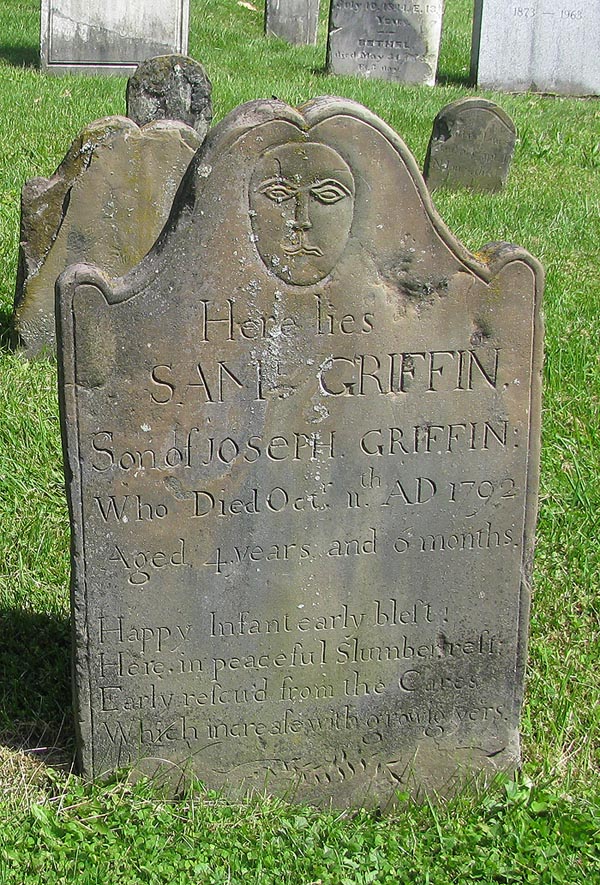
A few yards from the door of this chapel lies the grave of Samuel Griffin, the first person to be buried on this spot.  He died on October 11, 1792, accidentally drowned in the lake at the age of four years, six months.  On his stone, you can still barely pick out the epitaph verses:
            Happy infant, early blest
            Here in peaceful slumber rest
            Early rescu’d from the cares
            Which increase with growing years.

Now, I don’t know about you, but I find that epitaph hard to swallow.  It’s hard for me to imagine those as the words chosen by his mother, the ones that seemed to fit best as she held him dripping and cold in her lap at the shore of the lake. 

I guess it just sounds too easy.  Killed tragically while still a young boy, his whole life ahead of him—is that “happy infant, early blest.”  I’m sure they tried their best, but no one could save him, he had to die in such a frightening way—is that really “early rescued from the cares?”  Surely these words would speak only to someone who wasn’t ready to be honest about the real devastation of such a death—surely they’re trying to put a bright face on things when everything is falling apart inside?  

Monday, December 28, 2015

For Meditation: Contemplation Completed

"Christ’s saying about John, “I wish him to remain thus until I come,” suggests the state of contemplative virtue, which is not to be ended through death, as the active life is, but after death contemplation is to be more perfectly completed with the coming of the Lord …. For who gives bread to the hungry in that life where no one hungers? Who gives water to the thirsty where no one thirsts? Who buries the dead where it is the “land of the living” (Ps. 27:13)? Who carries out the rest of the works of mercy where no one is found to be in need of mercy? And so no laborious action will be there, but only the everlasting fruit of past action. Contemplative happiness, however, which commences here, will there be made perfect without end when the presence of the heavenly citizens and of the Lord himself will be seen, not through a mirror and in a dark manner as now, but face to face (1 Cor. 13:12)."  The Venerable Bede, quoted in Zachary Giuliano, "John and Peter, Patterns of Holy Life."  Covenant, 27 December, 2015.

Tuesday, November 24, 2015

For Meditation: Feelings for holy men in winter

“Such is the frame of mind which befits the end of the year; and such the frame of mind which comes alike on good and bad at the end of life. The days have come in which they have no pleasure; yet they would hardly be young again, could they be so by wishing it. Life is well enough in its way; but it does not satisfy. Thus the soul is cast forward upon the future, and in proportion as its conscience is clear and its perception keen and true, does it rejoice solemnly that “the night is far spent, the day is at hand,” that there are “new heavens and a new earth” to come, though the former are failing; nay, rather that, because they are failing, it will “soon see the King in His beauty,” and “behold the land which is very far off.” These are feelings for holy men in winter and in age, waiting, in some dejection perhaps, but with comfort on the whole, and calmly though earnestly, for the Advent of Christ.”


J. H. Newman, quoted in Will Brown’s “The Deterioration ofNature: On the Running Out of Time.”  Covenant.  24 Nov. 2015

Tuesday, November 17, 2015

For Meditation: A Second Plot

"In the story of salvation there is a second plot at work, running through the cold and hard one, inside of it, on top of it. The father has shocked us all by running toward us, his prodigal sons and daughters, in Jesus Christ, the Son of God. That same son died a lonely and defeated death in the holy city towards which he had run, but now he is raised. God has given to the history of humankind another end, all of his own making. Now, through and beyond doom, there is the new Jerusalem, the city of God, his kingdom. Through no power of our own, we are also journeying toward the day of the Lord and his victory."
Bishop George Sumner, "The Resurrection of the Dead."

Saturday, August 29, 2015

The Anchoress in the Loft

 
“Happy are they who dwell in your house! * they will always be praising you.”
Psalm 84:3

“How did we get a recliner and a coffee table up in the Rood Loft?” I asked Father Philip.  “Oh,” he smiled, “I guess you haven’t heard the story about our anchoress.”

But let me back up a bit.  I was a seminarian at the time, and a member of the congregation and an altar server at Pusey House.  Pusey House is technically not a church, but a “house of piety and learning,” and it’s the chaplaincy for high-church Anglican students at Oxford University.  It is housed in a beautiful neo-Gothic chapel, designed by the great Temple Moore, and the chapel is dominated by a life-size rood, a statue of Jesus on the Cross with St. Mary and St. John.  The rood is placed on a large platform called the rood-loft, a kind of balcony that goes across the breadth of the church about ten feet up, dividing the Chancel of the Church from the Nave.   If you’ve spent much time poking around old churches, you will know the Rood Screen, which is a smaller version of this—we had one in my last congregation that was maybe a foot wide.  But the Rood Loft at Pusey House was really a room of its own, 6 or 8 feet wide, with a tall stone parapet on either side.  I had been sent up onto it to retrieve some obscure liturgical implement, and that’s where I discovered the dusty recliner.

The Rood Loft, Father Philip went on to tell me, had been the home of Pusey’s resident anchoress for a few months a decade or so before.  An anchoress is a person called by God to a life of solitary prayer.  It’s a bit like a hermit, but while hermits tend to live in caves in the wilderness, anchorites or anchoresses live inside churches.  Back in the Middle Ages they were quite common, and Julian of Norwich, the beloved mystic quoted by Rev. Mary Thorpe in her sermon last week, was an anchoress in the Church of Saint Julian in Norwich back in the fourteenth century.  These days, they are much rarer.  In fact, as far as I know, the one from Pusey’s Rood Loft may have been the only anchoress in the modern history of the Anglican Communion.

Thursday, April 30, 2015

For Meditation: Eternal life

From my morning reading, Hughson's With Christ in God.

"Eternal life begun consists in knowing by faith--a tender and affectionate knowledge which inclines the soul to love.  Eternal life consummated consists in seeing God openly, face to face."  Bishop Bossuet (111).

Thursday, April 23, 2015

What's in a Name?

“Into the company of the blessed” is a phrase I’ve come to know and love from old collects and devotional prayers.  A prayer from Flowers of Piety (1840), for example, asks God that “I may believe in Thee, put my whole trust in Thee, love Thee above all things, and through the merits of Thy death and passion, be admitted into the company of the blessed, where I may praise Thee forever.”

In this prayer, the phrase clearly refers to the saints and angels who praise the Lamb forever.  This is the goal of the Christian life, to be with Christ and His saints in our true and lasting home.  To see Him and know His love completely is the greatest blessing of all, the promised rest at the end of this life’s struggles.  The hope of everlasting life and the communion of saints are among the strongest strains in my own spiritual life, themes toward which my meditations and writings often turn.