“Happy are they who dwell in your house! * they will always be praising
you.”
Psalm 84:3
“How
did we get a recliner and a coffee table up in the Rood Loft?” I asked Father
Philip. “Oh,” he smiled, “I guess you
haven’t heard the story about our anchoress.”
But let me back up a bit. I was a seminarian at the time, and a member
of the congregation and an altar server at Pusey House. Pusey House is technically not a church, but
a “house of piety and learning,” and it’s the chaplaincy for high-church
Anglican students at Oxford University.
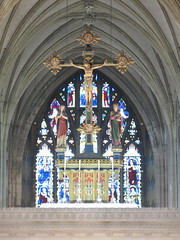
It is housed in a beautiful neo-Gothic chapel, designed by the great
Temple Moore, and the chapel is dominated by a life-size rood, a statue of
Jesus on the Cross with St. Mary and St. John.
The rood is placed on a large platform called the rood-loft, a kind of
balcony that goes across the breadth of the church about ten feet up, dividing
the Chancel of the Church from the Nave.
If you’ve spent much time poking around old churches, you will know the
Rood Screen, which is a smaller version of this—we had one in my last
congregation that was maybe a foot wide.
But the Rood Loft at Pusey House was really a room of its own, 6 or 8
feet wide, with a tall stone parapet on either side. I had been sent up onto it to retrieve some
obscure liturgical implement, and that’s where I discovered the dusty recliner.
The Rood Loft,
Father Philip went on to tell me, had been the home of Pusey’s resident
anchoress for a few months a decade or so before. An anchoress is a person called by God to a
life of solitary prayer. It’s a bit like
a hermit, but while hermits tend to live in caves in the wilderness, anchorites
or anchoresses live inside churches.
Back in the Middle Ages they were quite common, and Julian of Norwich,
the beloved mystic quoted by Rev. Mary Thorpe in her sermon last week, was an
anchoress in the Church of Saint Julian in Norwich back in the fourteenth
century. These days, they are much rarer. In fact, as far as I know, the one from
Pusey’s Rood Loft may have been the only anchoress in the modern history of the
Anglican Communion.
