"Does not the Light Itself call us to this rest when It says, Come unto Me, all ye that labour and are heavy laden, and I will give you rest: Take My yoke upon you and learn of Me, for I am meek and lowly in heart and ye shall find rest unto your souls. For My yoke is easy, and My burthen is light, For what heavy yoke does He put upon our mind's neck, Who bids us shun every desire that causes disquietude? What heavy burthen does He lay upon His followers, Who warns us to decline the wearisome ways of the world? So let the holy man consider with himself, that by the mystery of the Incarnation 'the Light' rescues the wicked from heavy toil, while It takes clean away all the aims of wickedness from their hearts; let him reflect how every converted person has already here below a taste, by inward tranquility, of that rest which he desires to have throughout eternity, and let him say, There the wicked cease from disturbance, and the weary in strength are at rest."
Gregory the Great, Moralia in Job IV,66.
Showing posts with label rest. Show all posts
Showing posts with label rest. Show all posts
Tuesday, June 28, 2016

Tuesday, January 12, 2016
For Meditation: "to live a perpetual Sabbath"
"For me personally, talking about God's work and God's rest and about humanity being made in God's image raises another question. My wife, Ann, has multiple sclerosis. She was able to have children, and we brought them up, and she worked as a psychiatrist, but eventually had to abandon her work. She now cannot move at all, hardly even to raise an eyebrow. She cannot do anything for herself or speak. Is she still a person in the image of God? Living with Genesis 1 and with Ann's increasing disability leaves me with several reflections. Because handicapped people are indeed human beings made in God's image, the rest of the world owes it to them to seek to make it feasible for them to have as much control over their lives as possible. We should help them master as much of the world as possible rather than take over and run their lives for them. But a kind of converse is that handicapped people remind the rest of us that being unable to work or even to do much of anything turns out not to mean you stop being human. Ann is obliged to live a perpetual Sabbath. It is not merely work that defines the person."
John Goldingay, Genesis for Everyone, Part One, 25-26.
John Goldingay, Genesis for Everyone, Part One, 25-26.
Saturday, August 29, 2015
The Anchoress in the Loft
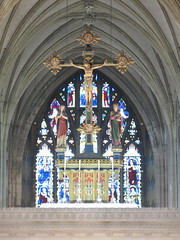
“Happy are they who dwell in your house! * they will always be praising
you.”
Psalm 84:3
“How
did we get a recliner and a coffee table up in the Rood Loft?” I asked Father
Philip. “Oh,” he smiled, “I guess you
haven’t heard the story about our anchoress.”
But let me back up a bit. I was a seminarian at the time, and a member
of the congregation and an altar server at Pusey House. Pusey House is technically not a church, but
a “house of piety and learning,” and it’s the chaplaincy for high-church
Anglican students at Oxford University.
It is housed in a beautiful neo-Gothic chapel, designed by the great
Temple Moore, and the chapel is dominated by a life-size rood, a statue of
Jesus on the Cross with St. Mary and St. John.
The rood is placed on a large platform called the rood-loft, a kind of
balcony that goes across the breadth of the church about ten feet up, dividing
the Chancel of the Church from the Nave.
If you’ve spent much time poking around old churches, you will know the
Rood Screen, which is a smaller version of this—we had one in my last
congregation that was maybe a foot wide.
But the Rood Loft at Pusey House was really a room of its own, 6 or 8
feet wide, with a tall stone parapet on either side. I had been sent up onto it to retrieve some
obscure liturgical implement, and that’s where I discovered the dusty recliner.
The Rood Loft,
Father Philip went on to tell me, had been the home of Pusey’s resident
anchoress for a few months a decade or so before. An anchoress is a person called by God to a
life of solitary prayer. It’s a bit like
a hermit, but while hermits tend to live in caves in the wilderness, anchorites
or anchoresses live inside churches.
Back in the Middle Ages they were quite common, and Julian of Norwich,
the beloved mystic quoted by Rev. Mary Thorpe in her sermon last week, was an
anchoress in the Church of Saint Julian in Norwich back in the fourteenth
century. These days, they are much rarer. In fact, as far as I know, the one from
Pusey’s Rood Loft may have been the only anchoress in the modern history of the
Anglican Communion.
Subscribe to:
Posts (Atom)