Showing posts with label resurrection. Show all posts

Saturday, November 4, 2017

Working Through Grief: A Sermon for All Souls Day

“I look for the LORD, my soul doth wait for him, in his word is my trust.”  Ps. 130:5

My father died of a sudden heart attack when he was 54.  I was 27, working my first real job, married for a month, and completely unprepared for navigating the rest of my life without my father’s guidance and support. 

It was the most traumatic thing I’ve ever experienced.  I know that doesn’t say very much compared to what many of you have endured.  But for me, it meant deep personal sadness at the loss of a man I deeply admired and who brought so much joy into my life.  It meant concern at the even more intense grief that my mother, my grandparents and my brother were experiencing.  And the experience left me feeling adrift, more hesitant and uncertain about the future, with a kind of fear in my heart I had never really known before.

I was deeply grateful that I knew I could pray for my father, with words that the church had placed in my mouth, when it was so difficult to know just what to say to God about it all.  My father died on a Sunday afternoon, and he was buried on a Wednesday.  The next Sunday morning I went to his grave, and I took with me a little volume, The Priest’s Book of Private Devotions, marked for the page for the Vespers for the Dead. 

Sunday, August 6, 2017

The Eighth Day of their Lives

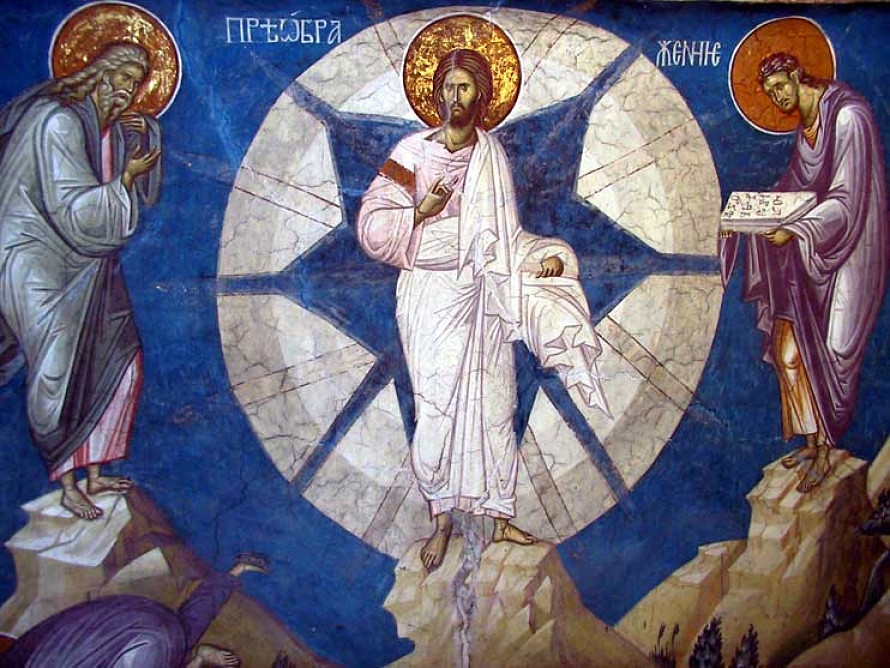
“And behold, two men talked with him, Moses and Elijah, who appeared in glory and spoke of his departure, which he was to accomplish at Jerusalem.”  St. Luke 9:30-31

Over the last few months, I’ve had several conversations with people who are staring down retirement.  Some friends are leaving their work with a deep sense of satisfaction, ready to take on some long-postponed projects.  Others are worried about how they will fill the time and are looking for a way to hang in for a few more years.  One friend was doing the most fruitful and fulfilling work of his career, but the funding ran out, and he’s facing part-time work, something quite different.  It might be marvelous, but I don’t think he’s completely sold on it yet. 

In the back of most of those conversations lay a series of questions I suspect we’ve all asked ourselves, even if retirement lies half a lifetime away: “Does my life add up? Does it have meaning, this work into which I have poured so much of my time and energy?  Do I have a legacy?”  It’s worth reminding ourselves that our privilege allows us to ask these questions of our work.  Most people in history and most people in the world today simply must toil on until their bodies give way.  But for all people, life is unpredictable, full of unexpected shifts, confusing blessings and overwhelming sorrows.  We long to understand where our lives are headed, how their true meaning will be revealed.  But so often, in the end, there is only confusion.  We see ourselves only through clouds of smoke, beset by doubt and fear. 

Sunday, June 4, 2017

Della Robbia at the National Gallery: Tender, Humble, and Devout

From the Sounds of St. Francis, 4 June, 2017
The terracotta statuary created by the Della Robbia family of Florence is instantly recognizable: white figures surrounded by vivid blue backgrounds, often wreathed by bright green leaves and fruit. But these statues don’t always get so much respect. Modern connoisseurs of high Renaissance art usually swoon over the Leonardos, Raphaels, and Michelangelos instead and galleries sometimes consign Della Robbia statues to the hallways or overstuffed “ojects d’arte” rooms.

In their own time, though, the Della Robbias (an uncle, a nephew and a grand-nephew) were highly regarded and received enormous numbers of commissions. In some ways, victims of their own success, the family developed a unique process for glazing terracotta, leaving behind vivid colors and a glassy sheen. Their impressive workshop method allowed extensive production for over a century. We tend to overlook their statues because there are so many of them, not just at world-class museums like the National Gallery, but in all sorts of private collections (including an impressive Madonna and Child that hung in the library of my former parish in Cooperstown). If you’ve been to Tuscany or Umbria you will know how cheap knock-offs of Della Robbia work abound in souvenir shops, cheapening one’s experience of beholding the real thing.

Sunday, April 16, 2017

Taking Easter Home


“Behold, he goeth before you into Galilee; there shall ye see him.”  St. Matthew 28:7

One of the special things about settling in the DC area for Allison and me is spending time in the city where we fell in love.  Back in the summer of 2003, I had just finished my studies at seminary and was getting ready to begin as a teacher at a boarding school near Hagerstown.  Allison was a public policy student completing her mandatory student internship at a organization on Capitol Hill.  I’d meet her after work in the grand hall of Union Station and we’d head off to one of those free concerts at the Kennedy Center or we’d sit and talk in one of those pleasant little parks near the Capitol, or share a meal in that most exotic and romantic locale, the food court in the basement of the train station.

Sometimes, when we’ve got the kids in the backseat and we’re headed off to a museum on the Mall or to see a friend who lives across town, we’ll drive by one of these places and tell them a little about what it meant to us then.   So much that has happened since then that we never expected, but many of the good things we do enjoy now were planted there.  Going back to those places, we fall in love again, or at least we understand something valuable about the love we share now, something we can only discover there, where it all began.

Sunday, April 2, 2017

In the House of Affliction

In the liturgical calendar, today, the Fifth Sunday in Lent, marks the beginning of Passiontide, when we shift our attention to Christ’s suffering and death. In the congregations where I have served before, we would mark this day by covering all the crosses in the church with purple veils.  This isn’t your practice here, probably because of the number of yards of purple cloth it would take to cover that cross suspended from the ceiling over the Altar. 

But it remains fitting to grapple with this Gospel text, the story of the raising of Lazarus, on this day.  The Book of Isaiah describes death as “the covering that is cast over all peoples, the veil that is spread over all nations.[1]”  Even if there are no cloth veils in the sanctuary, the events of the story we have just heard are shrouded by death’s power. 

Lazarus, is of course, a man destined to die from the beginning of the story, and he will rest in the tomb for four days before Jesus arrives.  His sisters are shattered with grief, and they are surrounded by a crowd of mourning friends, who seem to be trying, without much success to offer comfort.  Even the name of their village, Bethany, gives the measure of things—it means “the house of affliction[2]”

Tuesday, April 5, 2016

The coup

“But Peter and the apostles answered, ‘We must obey God rather than human authority.’”  Acts 5:29

There are a few Sundays a year when it would be nice if the lectionary creators had lined up our Scripture lessons in chronological order. Today would be one of them. We started with a story from the early church, then moved to a vision of the last days and then back to one of Jesus’ first resurrection appearances: that’s enough time travel to make Marty McFly’s head spin.

So let’s start again, and tell the story in order this time.  It begins with the disciples, hiding that first Easter evening in a locked upper room. They were terrified, confused, grieving, and lost. They were afraid of those who held the power, especially the temple authorities who had handed Jesus over to be crucified, and who might have them next on their list. They were still mourning Jesus’ death and the way that it had dashed all their hopes.  They were confused about the events of the morning: an empty tomb, a vision of angels, maybe Magdalene had even seen the Lord.  But what did it all mean?  Where was Jesus?  When would they see Him again, and what would He think of them?  What comes next? 

Sunday, March 27, 2016

Public Address System

“The men said to them, ‘Why do you look for the living among the dead?  He is not here, but has risen.’”  St. Luke 24:5

The Metro, as you know, is having trouble.  There are serious concerns about financial sustainability, loads of deferred maintenance, diminishing public trust.  They’ve recruited a no-nonsense administrator, Paul Wiedefeld, to put things in order.  Earlier this month, he shut the whole thing down for a day to repair the electric cables.  The grumbling was universal.  It also made for a very crowded Panera in Herndon and may well have proved that we can run the Federal government just fine out of Fairfax County so long as we have decent wi-fi. 

We’re told that the cables are now all ship-shape, and they will be on to additional projects.  And I, at least am hoping they will soon move on to the public address system.  Because if you have spent much time on Metro, you will know just how impossible it often is to understand what is being announced to you.  “Next station..mmmfmfm” or “The train will be delayed…ffhghf.”  I think the announcers were trained by the adults on those old Charlie Brown cartoons.  It’s really pretty bad.  If I’m travelling by Metro, I need to stand near the Metro map so I can tell what’s coming next.

Saturday, March 26, 2016

Alleluia! Alleluia! Alleluia!

“So you also must consider yourself dead to sin and alive to God in Christ Jesus.” 
Romans 6:11

“Alleluia, Alleluia, Alleluia!”  We have been waiting six weeks to hear those words, and only just now we proclaimed them, and the lights went on, and we sang a hymn of praise, and read the Easter Gospel.  Alleluia, for Christ is risen!  “Praise to the Lord,” that’s what it means, “Praise to the Lord.”  It’s the same in both English and Spanish, because it comes from Hebrew, the language of God’s ancient people.  It’s the shout of victory, the joyful song of the redeemed.  “Alleluia, Alleluia, Alleluia!”

Adrienn, our new musician here, has so graciously stepped in to play for us tonight.  And besides her excellent work on the piano and with the choirs, she is an instrumentalist, a teacher of strings.  Because she’s a violinist, she knows a great deal about fugues.  Fugues are musical selections in which a given theme, stated at the beginning, is repeated in a seemingly endless series of variations.  Bach wrote some of the finest ones, and occasionally we hear one as a postlude on Sunday morning.   As we repeat the theme in a fugue, we gradually become aware of dimensions and possibilities within the original melody that we hadn’t noticed before.  The melody comes to take on a new kind of life, with increasing complexity and power.  And as the fugue unfolds, the pace speeds up and grows louder, until it settles on a great resounding chord, all the stops pulled, a sound as big as glory.  That’s what tonight is all about.  It’s all one grand fugue, this Easter Vigil, and here’s the melody: “Alleluia, Alleluia, Alleluia.” 

Job's answer

“If a man die, shall he live again?  All the days of my service I would wait, till my release should come.”  Job 14:14

“I would wait,” Job said.  The Book of Job is full of unanswered questions, of frustrating riddles, disappointing shortcuts.  Job is in misery, and he cannot understand why.  His friends offer advice that rings hollow.  They blame him for things he knows he never did.  They claim logic and justice in God that Job cannot see.  Job has lost everything, he is at the point of death, hopeless and desperate.  But he will not give up.  He wants an answer, a trial where he can present his case, and a fair judgment will follow.  He wants to face God and know, once and for all, why all of this has come upon him. 

And in his quest, he runs head on into the great cul-de-sac of life.  Man is mortal, we all must die.  “We are of few days, he says, and full of trouble.”  We fade like a flower, we are cut down like a tree, we dry up like a pond.  God has allotted us a few days, and after that there is no more.  We will never rise, even if the whole created order falls to pieces.  After death, there is nothing.  No man gets his answer.

Sunday, January 17, 2016

He is the new wine

“The mother of Jesus said to him, ‘They have no wine.’”  St. John 2:3

A friend of mine made her debut on reality TV a few years ago.  Now, this was in England, where they spend even less on broadcast production than here, and where they seem to find the clergy endlessly fascinating.  She was part of a series that followed newly ordained clergy in her rural diocese in the West Country.

And when the time came for her to officiate at her first wedding, the BBC camera crews were on hand.  She was nervous, of course, and I guess her hands shook a bit, and she would be the first one to say that she’s always been a little clumsy.  She took the rings, as she practiced many times before, and laid them on her open prayer book for the blessing.  And then she dropped them—right through enormous cast iron grate on the chancel floor, down into the belly of a Victorian coal furnace.  I think they ended up calling the local fire department to get them out.  Of the hundreds of hours of film they shot that summer, well you can guess which scene got top billing in that episode.

Friday, May 15, 2015

For Meditation: Jesus is Angling for You

From my morning reading--Cyril of Jerusalem, quoted in John Laurence's The Sacrament of the Eucharist.  

"Perhaps you did not know whither you were coming or in what kind of net you are taken.  You have come within the nets of the church.  Be taken alive and flee not.  For Jesus is angling for you, not in order to kill, but by killing to make you alive.  For you must die and rise again."  (20).

Thursday, May 14, 2015

For Meditation: If it Weren't True

A friend sent this to me yesterday, a word about lying and truthtelling written by a man who, by his own admission, came to know a great deal about both.

"I know the resurrection is a fact, and Watergate proved it to me.  How?  Because 12 men testified that they had seen Jesus raised from the dead, and then they proclaimed that truth for 40 years, never once denying it.  Every one was beaten, tortured, stoned, and put in prison.  They would not have endured that if it wasn't true.  Watergate embroiled 12 of the most powerful men in the world--and they couldn't keep a lie for three weeks.  You're telling me 12 apostles could keep a lie for 40 years?  Absolutely impossible."  Chuck Colson.

At Christ Church, we have a rose window with twelve petals.  Each petal represents an apostle and depicts the symbol of his martyrdom.  I'd never before recalled that for what it really is, 12 testimonies to the truth of the resurrection.

Thursday, April 23, 2015

A Word of Mercy: Sermon for Easter II

“Jesus said to them again, "Peace be with you. As the Father has sent me, even so I send you." St. John 20:21

            “The doors were locked for fear,” Saint John tells us.  The disciples were huddling in the dark that first Easter evening, ducking and covering from all the drama that the spectacle at the empty tomb was likely to unleash.  It’s a rather odd postlude to the joyful news of Easter morning.  By sunset, there were no alleluias in sight.  An angel had proclaimed His resurrection. Christ had appeared to Mary Magdalene.  But the disciples didn’t really know what to make of it all.  Their initial excitement had deflated as they tried to come to terms with what the announcement might really mean for them.
 St. John remembered that they were frightened of the Jews, the religious authorities, who had a court and a police force of their own.  Jesus had seen the rough end of their justice a few days earlier, and once the news got out that there was no body in the tomb, they’d be out looking for someone to blame.  Tomb robbery was a serious crime, and though the disciples were innocent of it, the Sanhedrin didn’t seem to have much trouble rounding up false witnesses.  Announcing that the true Messiah had been raised by God, that the new creation had begun--that was even more dangerous, as some of them would find in a few weeks’ time.