Showing posts with label Gospel. Show all posts

Sunday, June 18, 2017

God visits His people in strangers

My lord, if I have found favor in your sight, do not pass by your servant… since you have come to your servant.”  Genesis 18:3,5

I picked up Sarge just outside of Oneonta, and told him I was only going as far as Cooperstown, but he was welcome to the ride.  He was familiar to me, a fixture of the Otsego County landscape, but we’d never spoken before.  Sarge was maybe 75, a thin man with leathery skin and squinty eyes.  He always wore a garrison cap and an olive-green army uniform, with a few medals sprinkled across the chest.   No one was quite sure if he had actually earned them or if they were just window dressing.  But in patriotic upstate New York, Sarge could hitch his way from one end of the county to another by just putting on a good show. 

He began talking the moment he sat down and kept it up for a solid half hour, a rambling discourse mostly about old cars, and the evils of politicians.  Looking over after about twenty minutes, he noticed I was a clergyman and launched into a discussion of true Christians and hypocrites.  Sarge had been to most of the churches in these parts, he assured me, and he could certainly tell the difference between them.  Catholics wouldn’t give a man like him the time of day, and would you believe that they once ran him out of a Pentecostal church because he stood up to speak his mind during the service.  But Methodists—they laid on the best spread for coffee hours, and sometimes the fellas would even slip him a few cigarettes. 

It did cross my mind as he opened the door to go his way that Sarge could well have been a kind of messenger.  I was a little relieved that he didn’t seem to know anything about Episcopalians, so he hadn’t turned up in my congregation and discovered that we came up short.  Wouldn’t it be just like God to separate the true believers from the false ones by the way they responded to a mysterious stranger?

Sunday, February 19, 2017

Christ at the Center: Exploring the Liturgy of the Word

“For no other foundation can any one lay than that which is laid, which is Jesus Christ.”
I Corinthians 3:11

If you are joining us today for the first time, I should explain that in the Episcopal Church it’s our practice to have one, not three sermons, and that after rather than before the Scripture readings.  But today, my purpose is to provide an instruction about this service we celebrate week by week, the Holy Eucharist, which is the highest and most ancient form of Christian worship.  Today we explore the first part of the worship service, the Liturgy of the Word.  As Saint Paul reminds us in today’s Epistle, Christ is the foundation on which all His Church’s work depends.   The Liturgy of the Word, above all, testifies to Him, and places Him at the center of the life we share as His people.

Our worship begins with a hymn, hopefully one that announces a theme appropriate to the season or the particular readings that will be presented later in the service.  Hymns are a relatively new addition to the Eucharistic liturgy, only becoming popular with Episcopalians about a hundred and fifty years ago.  Their practical function is to cover the time those leading the service need to get from place to place.  But many of our hymns teach the faith with power or, like the one we have just sung, are moving personal prayers.  Many of our hymns have stirring tunes, but the texts are deeply important, and serve as a kind of supplementary prayer book.  We pray that in all things, we may live as we sing. 

Then follows an acclamation of the One who has brought us together, God whom we praise.  In this season, we especially recall that He is merciful, the forgiver of our sins.  To praise God requires our very best, an uplifted mind, a pure heart—an answer in kind to His abundant love for us.

Friday, February 10, 2017

Bringing Back the 'Gesimas: A Liturgical Proposal

From Covenant, 10 Feb. 2017

My mother is a church organist, and my brothers and I spent many Saturday afternoons roaming freely around the church’s dusty corners while she worked out her footpedals and chose her stops for the next morning’s selections. Sometimes, when rehearsal was finished, we would help her find the numbers for the hymnboard that hung over the pastor’s chair.

The wooden box that held the hymn numbers also had a section for the words that made up the Sundays and festivals of the Church Year. We were Reformed, but the liturgy’s patterns were still important for us, and I knew most of the words on the black cards well enough: Advent and Lent, Christmas and Pentecost, New Year and Harvest Home.

The longest cards, though, at the back of the stack, were always a bit of a puzzle. They were shinier and less crinkled than the others, and obviously hadn’t been used in a long time. The names were certainly unusual: Quinquagesima, Septuagesima, Sexagesima. Young boys have rather vivid imaginations; I wondered just what kind of religious undertakings were intended for such occasions. Exotic ones, to be sure. Mother didn’t really know. The names sounded Latin, she thought, and maybe someone had sent our little church the Church Year cards intended for the Catholics or Episcopalians.

Monday, September 26, 2016

Ponder: "mission is an expression of Pentecost"

"Without the Spirit, God is far away, Christ belongs in the past, the gospel is a dead letter, the church is a mere organisation, mission is turned into propaganda.  But in the Spirit, God is near, the risen Christ is present with us here and now, the Gospel is the power of life, the church signifies Trinitarian communion, mission is an expression of Pentecost."

Ignatios IV, qtd. in Graham Tomlin, "The Prodigal Spirit and Church Growth" in Towards a Theology of Church Growth (2015), 142.

Sunday, March 27, 2016

Public Address System

“The men said to them, ‘Why do you look for the living among the dead?  He is not here, but has risen.’”  St. Luke 24:5

The Metro, as you know, is having trouble.  There are serious concerns about financial sustainability, loads of deferred maintenance, diminishing public trust.  They’ve recruited a no-nonsense administrator, Paul Wiedefeld, to put things in order.  Earlier this month, he shut the whole thing down for a day to repair the electric cables.  The grumbling was universal.  It also made for a very crowded Panera in Herndon and may well have proved that we can run the Federal government just fine out of Fairfax County so long as we have decent wi-fi. 

We’re told that the cables are now all ship-shape, and they will be on to additional projects.  And I, at least am hoping they will soon move on to the public address system.  Because if you have spent much time on Metro, you will know just how impossible it often is to understand what is being announced to you.  “Next station..mmmfmfm” or “The train will be delayed…ffhghf.”  I think the announcers were trained by the adults on those old Charlie Brown cartoons.  It’s really pretty bad.  If I’m travelling by Metro, I need to stand near the Metro map so I can tell what’s coming next.

Thursday, December 3, 2015

For Meditation: It takes the whole world to know the whole gospel

"He maintains that God is present on earth, that he made the earth and declared it “good,”  and that Christ is the unifying force and presence holding the entirety of earth together. The creation reveals the creator; the earth reveals Christ.

“Therefore,” states Kaoma, “in ecological terms, this manifestation of divine glory is revealed fully in the complex web of life.”[8] It takes the whole world to know the whole gospel. According to this thinking, to participate in destroying the earth is to participate in destroying the revelation of the Creator God. Kaoma moves from talking of “missio Dei” to “missio Creatoris Dei” — from “the mission of God” to “the mission of the creator God,” and he stresses that constantly upholding, renewing, and sustaining the earth is intrinsic to the creator God’s mission. He argues that the prophet Isaiah “was right when he proclaimed God’s salvation as an advent of the new creation, where all creatures will live in perfect shalom.”[9] And so, for Kaoma, climate justice involves joining God’s wider mission for the salvation of the earth as much as it involves joining with his mission for the salvation of humanity."
Graham Kings, "Climate Justice: Insights from African Anglican Theologians" Covenant, 2 Dec. 2015

Sunday, October 18, 2015

The "Real Doctor's" Message

“And [God] gave skill to human beings that he might be glorified in his marvelous works.”
Sirach 38: 6

“Down in Guatemala,” he told me, “I had to be a real doctor, and it scared the heck out of me.”  Now don’t get me wrong, according to the standards of the American Medical Association and the licensing agencies of his rather lucrative specialty, my parishioner was very much a real doctor.  He had been in practice for decades and was highly regarded in our community, sought out by people in need of surgery.  But things were different, he was telling me, when he went to Guatemala on a medical mission trip with his son’s church. 

They were working in a remote area, with very minimal equipment, you see.  There were no MRI machines and it was a day’s journey over rugged roads for an x-ray.  They could do simple blood tests, and had a few diagnostic tools, and some basic medicines but that was about it.  My parishioner said he had learned all about diagnosis back in medical school, but it was so much easier just to run a test and be sure.  Here in Guatemala, he had to listen to the stories, mark just how people described their symptoms.  It was really challenging work, and he wasn’t certain about a few of the cases he had seen.  There were some maladies he just couldn’t treat. 

Malpractice insurance companies, of course, don’t tolerate this much guesswork here, and that’s probably a good thing.  But it was interesting to me that my parishioner didn’t think of his work within these narrow limits as useless.   “A real doctor,” that’s what he called himself, someone stretched to use all his ingenuity, to listen more carefully, to treat the whole person and not just the symptoms.  He left that time in Guatemala a bit wistful about the more accurate and lucrative way he practiced medicine the rest of the year, and anxious to get back again to a place where he really do justice to his profession.

Saturday, June 13, 2015

Saying Farewell

The following was my final column in the Christ Church Chronicle, June-August, 2015

“And now I commend you to God and to the word of his grace, which is able to build you up and to give you the inheritance among all those who are sanctified.”  Acts 20:32.

As I prepare to leave this congregation and community, I have been thinking a great deal about the Bible’s many farewells.  Some, like Jacob’s farewell to his wily uncle Laban were testy moments, with tension just below the surface.  Others, like Moses’ valedictory sermon (the whole Book of Deuteronomy), Jacob’s parting blessings for his sons, and Christ’s glorious ascension were uplifting and consoling times, full of healing and guidance for the future.

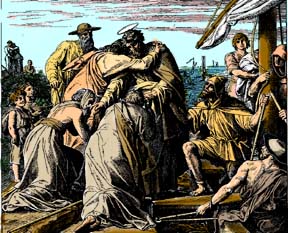
Saint Paul’s farewell to the Church at Ephesus, which is recounted at length in Acts chapter 20 is probably my favorite Biblical farewell.   Saint Paul was the first to bring the Gospel of Christ to Ephesus, and he had raised up a congregation of believers there and trained new leaders to oversee the church’s work.  But Saint Paul was a missionary, and in time he was called on by the Spirit to serve in a new place, among unfamiliar people.  The Ephesian elders accompanied him to his boat, St. Luke remembered, with prayers and tears.  And there on the beach, he offered a final sermon.