"Without the Spirit, God is far away, Christ belongs in the past, the gospel is a dead letter, the church is a mere organisation, mission is turned into propaganda. But in the Spirit, God is near, the risen Christ is present with us here and now, the Gospel is the power of life, the church signifies Trinitarian communion, mission is an expression of Pentecost."
Ignatios IV, qtd. in Graham Tomlin, "The Prodigal Spirit and Church Growth" in Towards a Theology of Church Growth (2015), 142.
Showing posts with label mission. Show all posts
Showing posts with label mission. Show all posts
Monday, September 26, 2016

Saturday, April 9, 2016
ACC Hears Reports of Crises
From The Living Church, 9 Apr 2016.
LUSAKA, Zambia — The deep needs of local churches and opportunities for joint action across the Anglican Communion were topics of discussion by the Anglican Consultative Council. Evangelization, discipleship, the worldwide migration crisis, climate change, and violence were identified as urgent global issues.
The Rev. Philip Groves, director of the Anglican Communion’s Continuing Indaba project, led the exercise. Participants reflected in small groups on the Five Marks of Mission developed by the ACC, and to discuss needs and priorities that are emerging in their local contexts.
Thursday, December 3, 2015
For Meditation: It takes the whole world to know the whole gospel
"He maintains that God is present on earth, that he made the earth and declared it “good,” and that Christ is the unifying force and presence holding the entirety of earth together. The creation reveals the creator; the earth reveals Christ.
“Therefore,” states Kaoma, “in ecological terms, this manifestation of divine glory is revealed fully in the complex web of life.”[8] It takes the whole world to know the whole gospel. According to this thinking, to participate in destroying the earth is to participate in destroying the revelation of the Creator God. Kaoma moves from talking of “missio Dei” to “missio Creatoris Dei” — from “the mission of God” to “the mission of the creator God,” and he stresses that constantly upholding, renewing, and sustaining the earth is intrinsic to the creator God’s mission. He argues that the prophet Isaiah “was right when he proclaimed God’s salvation as an advent of the new creation, where all creatures will live in perfect shalom.”[9] And so, for Kaoma, climate justice involves joining God’s wider mission for the salvation of the earth as much as it involves joining with his mission for the salvation of humanity."
Graham Kings, "Climate Justice: Insights from African Anglican Theologians" Covenant, 2 Dec. 2015
Wednesday, May 20, 2015
"In His Glory"--Sermon for Easter 7
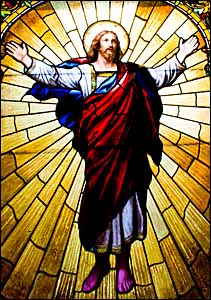 “All mine are thine, and
thine are mine, and I am glorified in them.”
St. John 17:10
In the
Name of the Father, and of the Son, and of the Holy Spirit, Amen.
“She was in her glory today.” That’s what my father would say when he was
describing my grandmother at a family reunion, carrying out the groaning
platters, a baby cradled in one arm, beaming for all the world to see. It’s how he described my brother that time
the bases were loaded and he sent the ball over the left field wall. I remember him teasing my mother, returning
home from a day shopping with her friends.
There were a few more bags in the back seat than he had been expecting,
and that’s what he said—“well, I can see you were in your glory today.” I think it’s a rather old-fashioned
expression these days, but we still know what it means.
To be one’s glory means to feel deep
happiness, a sense of fulfillment. We
are in our glory when we are doing that thing we are truly made to do, when our
distinctive talents are put to use, and others respond to us with respect and
admiration. We smile when we are in our
glory. A kind of light seems to shine
from our faces.
Subscribe to:
Posts (Atom)