Showing posts with label Anglicanism. Show all posts

Wednesday, August 16, 2017

Zeal and Patience, Part IV

Originally published on Covenant, 19 July, 2017
A similar uncertainty surrounds the affirmations about our essential unity of belief regarding the Holy Eucharist. It is true that This Holy Mystery: A United Methodist Understanding of Holy Communion affirms “the real, personal, and living presence of Jesus” in the sacramental elements (though “in temporal and relational terms”). However, assorted practices surrounding the celebration and administration of Holy Communion in United Methodist Churches stand at some tension with this claim, as they deviate so seriously from historical norms.
Much of the online discussion has centered on whether the Methodist requirement that Holy Communion be celebrated with “the pure, unfermented juice of the grape” can be squared with the Chicago-Lambeth Quadrilateral’s that the Holy Communion be “ministered with unfailing use of Christ’s words of institution and of the elements ordained by Him.” More serious is the nearly universal United Methodist practice of admitting the unbaptized to Communion and the widespread authorization for celebrating Holy Communion by licensed local (unordained) pastors.

Thursday, August 3, 2017

Zeal and Patience, Part II


As the Episcopal and United Methodist churches consider a full-communion agreement, this article continues the story of the zealous John Wesley and  the patient Samuel Seabury, the founders of the two churches.  It outlines a missed opportunity for a united church in 1784, and what the failure then may still be able to teach us today.  The article was first published on The Living Church's Covenant blog on 12 July
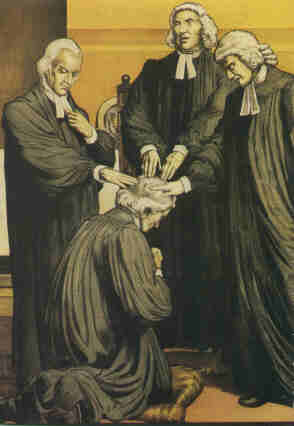
As Wesley sent off his letter, and Thomas Coke with it to come to America with the purpose of ordaining his preachers, another Anglican priest was also travelling about Britain. Samuel Seabury, bishop-elect of Connecticut, was pursuing a different potential solution to American Anglicanism’s pastoral crisis, one he believed to be essential to “follow[ing] the Scriptures and the Primitive Church.” Seabury was in search of three bishops who would consecrate him, so that episcopacy might be carried back to his native land.
Seabury’s zeal in pursuit of his cause cannot be doubted, but he was above all a patientman. For nearly a year and a half, he met with a number of English bishops to plead his case, some of them multiple times. Like Wesley, he was rather woodenly rebuffed by Robert Lowth, the Bishop of London, who could not imagine the prospect of consecrating a bishop who lacked a warrant from the Connecticut state legislature. Some of Seabury’s countrymen were using their personal contacts to work against his case, including the bishop-elect of Maryland, William Smith, who distrusted Seabury because he had been a loyalist. Deeply frustrated by delays and inconclusive answers, Seabury wrote to a fellow Connecticut clergyman, “I shall be at my wits’ end. … This is certainly the worst country in the world to do business in” (Letter to Abraham Jarvis).

Tuesday, April 26, 2016

The Witness of Love


“Just as I have loved you, you also should love one another. By this everyone will know that you are my disciples, if you have love for one another."  St. John 13:34-35

It is good to be back with you this morning.  As some of you will know, I have been in central Africa for the last few weeks.  I have spent a little of my time watching magnificent wild animals, and a little of it eating delicious wild animals, and a little of it explaining to bewildered Zambian taxi cab drivers how it can possibly be that Donald Trump is doing so well in the primaries.

But most of my time has been spent attending and writing stories about an important meeting of the worldwide Anglican Communion.  I was sent to Africa as a reporter for The Living Church, a magazine and website that serves the Episcopal Church, to report on the meeting of the Anglican Consultative Council that was being held in the Cathedral in Lusaka, Zambia.  If you want to read a few of my articles that summarized what was happening, you find them on The Living Church website. 

Tuesday, April 19, 2016

The Consequences Stand

from The Living Church, 19 Apr. 2016

LUSAKA, Zambia — Though the Anglican Communion continues to face deep divisions, the Anglican Consultative Council closed its meeting today with a deep resolve to walk together.

“Our conversations were enriching, not embattling,” said the Rt. Rev. Jane Alexander, an ACC delegate from Canada.

“I genuinely felt there was an outstanding graciousness and generosity shown on all sides,” said the Most Rev. Richard Clarke, Archbishop of the Church of Ireland. “It was a real victory for the spirit of Anglicanism.”

Monday, April 18, 2016

ACC Churns Out Resolutions

from The Living Church, 18 Apr. 2016

LUSAKA, Zambia: In just a few hours, Anglican Consultative Council delegates passed a flurry of 44 resolutions, with an absence of acrimony and division.

Resolution C34, proposed by delegates from South Sudan, called upon the ACC to receive the report of the January Primates’ Meeting, including consequences for the Episcopal Church detailed by the primates’ communiqué. It affirmed “the commitment of the Primates of the Anglican Communion to walk together; and commits to continue to seek appropriate ways for the provinces of the Anglican Communion to walk together with each other and with the Primates and other Instruments of Communion.” As part of the consent agenda, the resolution was received without objection and passed without amendment.

ACC Picks Diverse Leaders

from The Living Church, 18 Apr. 2016

LUSAKA, Zambia — The Anglican Consultative Council has chosen a diverse slate of leaders for its standing committee.

The Rt. Rev. James Tengatenga, the ACC’s chairman, reminded members of their constitutional mandate to consider “the desirability of achieving (so far as practicable) appropriate regional diversity and a balance of representation between clergy and laity and between the genders.”

Delegates chose a new vice chairwoman and five standing committee members from provinces that represent the Communion’s worldwide mission as well as a diversity of positions on the issues testing the stability of its union. In most cases, members of the standing committee serve for six years.

Saturday, April 16, 2016

Youth Concerns Not Limited to Global North

from The Living Church, 16 Apr. 2016

LUSAKA, Zambia — Anglican churches risk losing youth from their churches if they fail to respond creatively to the challenges of emerging youth culture, according to the Rev. Robert Sihubwa, Youth Coordinator for the Province of Central Africa. “The Anglican Church in the Global South shares the same structures, liturgy, and theology with Anglicans in the North. Is what happened in the North going to happen in the Global South as well? Are we headed in a direction where we will also say, ‘We used to have young people in the church?’”

Anglican Consultative Council delegates joined with church leaders from across the Diocese of Lusaka today for a conference on mission and ministry at Holy Cross Cathedral in Lusaka. Though delegates from several parishes and church organizations made presentations, a drama and following panel discussion focused on the needs of youth attracted the most attention.

The drama, which was acted out by members of Lusaka’s Anglican Youth Fellowship, featured a young man abandoning the dull fellowship of his local Anglican parish to party with his friends on Sunday morning. He was drawn back, though, by a group of dancing young people, accompanied by a pastor rapping the words to Amazing Grace.

Welby: Time to Act on Violence, Climate Change

from The Living Church, 16 Apr. 2016

LUSAKA, Zambia — Archbishop of Canterbury Justin Welby used his presidential address to urge Anglicans to look outwards, “seeking to serve the work and mission of God in the world.” He called for decisive action on religiously motivated violence and climate change, which he described as “major, global conflicts with a very clear religious content.” The address followed Choral Evensong at the Anglican Consultative Council meeting in Lusaka, as delegates began to turn their attention to a series of resolutions that will guide the Communion’s life and work for the next three years.

As a worldwide network sharing a “coherent structure,” Welby said that Anglicans are uniquely positioned to make an impact on these two pressing issues, which he described as “actors [that] dominate the world stage.”

Friday, April 15, 2016

ACC Elects Apb. Paul Kwong

from The Living Church, 15 Apr. 2016

LUSAKA, Zambia — The Most Rev. Paul Kwong, Archbishop of Hong Kong, was elected chairman of the Anglican Consultative Council on Friday. Archbishop Kwong, 65, is the first sitting primate to be elected to the position and will serve a six-year term.

Archbishop Kwong has served as primate of the Province of Hong Kong since 2007, and is Bishop of Hong Kong Island. He has served as a primatial member on the ACC’s Standing Committee since 2011, and in that capacity has participated in two ACC meetings. He was the local organizer for the ACC’s meeting in 2002, which met in Hong Kong.

Kwong described himself as “deeply honored and humbled by the election,” and said Anglican unity would be his primary focus: “I think the most important work we have to do is to hold the Communion together, and to bring the people of different views together, and to work together and to serve together.”

Thursday, April 14, 2016

ACC Hears Glad Tidings

from The Living Church 14 Apr. 2016

LUSAKA, Zambia — The Anglican Consultative Council has considered new ecumenical agreements with Methodist, Orthodox, and the Oriental Orthodox churches as well as theological work seeking to unify the Instruments of Communion
.
The Rev. Canon John Gibaut, the Anglican Communion’s Director for Unity, Faith, and Order, presented several statements for approval to the delegates April 13. The statements had been prepared under the supervision of the Inter-Anglican Standing Commission on Unity, Faith, and Order (IASCUFO), the Communion-wide team of 25 theologians responsible for doctrinal and ecumenical work.

For Anglicans, Gibaut said, the search for Christian unity is central to the practice of discipleship. He finds, though, in his conversations with ordinary Anglicans that many seem to confuse unity with uniformity or conformity.

Tuesday, April 12, 2016

ACC-16 Hears of Persecution

from The Living Church, 12 Apr. 2016

LUSAKA, Zambia — Delegates to the 16th Anglican Consultative Council have heard harrowing accounts of persecution across the world.

In his report to ACC delegates, the Most Rev. Idowu-Fearon discussed his role as the Communion’s secretary general in providing spiritual support and advocating on behalf of Anglicans who suffer persecution.

The secretary general said he has advocated on behalf of Anglicans in Pakistan in the aftermath of the Easter Day attacks in Lahore, which killed 72 people and injured 300.

Monday, April 11, 2016

Idowu-Fearon Speaks Up

From The Living Church, 11 Apr. 2016

The Anglican Communion secretary general has denounced accusations of interference in whether Church of Kenya would send a delegation to the 16th Anglican Consultative Council.

The Most. Rev. Josiah Idowu-Fearon called the accusations, reported by George Conger in Anglican Ink, “scurrilous” and “made in a manner against all biblical principles of appropriate behavior.”

The Most Rev. Eliud Wabukala, primate of the Anglican Church of Kenya, had announced that his province would boycott the ACC Meeting because of concern that ACC leaders would not sufficiently enforce the consequences requested by the January Primates’ Meeting. A letter appeared briefly on the Anglican Church of Kenya’s website that said Archbishop Wabukala had reversed his position.

Iduwu-Fearon Hails Task Force

From The Living Church, 11 Apr. 2016

LUSAKA, Zambia — The Episcopal Church will take additional steps to respect the consciences of those who disagree with same-sex marriage, and the Anglican Covenant is far from dead, the Most Rev. Joshua Idowu-Fearon told delegates to the Anglican Consultative Council today in Lusaka.
Archbishop Idowu-Fearon, secretary general of the Anglican Communion, addressed both topics extensively in a report of his work since he began in this role several months ago.

The archbishop said he had recently visited the United States to participate in the consecrations of the Rt. Rev. Peter Eaton, Bishop of Southeast Florida, and the Rt. Rev. George Sumner, Bishop of Dallas. He also was the keynote speaker at a mission conference in the Diocese of Connecticut, which the Rt. Rev. Ian Douglas, one of the Episcopal Church’s ACC delegates, serves as bishop.

The archbishop said he met with Presiding Bishop Michael Curry to discuss the situation of those remaining within the Episcopal Church who reject General Convention’s recent decision to authorize the blessing of same-sex marriages.

Sunday, April 10, 2016

5000 Celebrate in Zambia

LUSAKA, Zambia — Amid pounding African drums, Archbishop Justin Welby opened the 16th Anglican Consultative Council with a festival Eucharist on the grounds of Holy Cross Cathedral. About 5,000 Anglicans from the Province of Central Africa’s four nations, Botswana, Malawi, Zambia, and Zimbabwe, gathered for the service.

Most wore the uniforms of church societies and guilds. The service, which lasted about four and a half hours, included grand processions, multiple performances by choirs, brass bands, and praise groups, a sermon by Archbishop Welby, and greetings from Zambia’s president, Edward Chagwa Lungu.

Saturday, April 9, 2016

ACC Hears Reports of Crises

From The Living Church, 9 Apr 2016.

LUSAKA, Zambia — The deep needs of local churches and opportunities for joint action across the Anglican Communion were topics of discussion by the Anglican Consultative Council. Evangelization, discipleship, the worldwide migration crisis, climate change, and violence were identified as urgent global issues.

The Rev. Philip Groves, director of the Anglican Communion’s Continuing Indaba project, led the exercise. Participants reflected in small groups on the Five Marks of Mission developed by the ACC, and to discuss needs and priorities that are emerging in their local contexts.

Friday, April 8, 2016

Applause for a Notion

From The Living Church, 8 Apr. 2016

LUSAKA, Zambia — The first day of the 16th Anglican Consultative Council focused on “establishing the ACC Community,” with discussion of the recent Primates’ Gathering, a dramatic reading of the Book of Ruth, and the joyful song of a local church choir.

“The cathedral and diocese have been praying for you; not just for this conference, but for unity in the church,” said the Very Rev. Charles Thomas, dean of the Cathedral of the Holy Cross in Lusaka. “The world is watching. The world is waiting.”

Thursday, April 7, 2016

Youth Celebrate Creation

From The Living Church, 7 Apr. 2016

LUSAKA, Zambia — Solar energy, green manure, tree planting, and forcing extension agents to get out from behind their desks to serve the people will all be in the future of “Green Anglicanism.”
That’s the word of young Anglicans from across Central and Southern Africa at a conference held in conjunction with this week’s opening of the Anglican Consultative Council.

“Young Green Anglicans: Intentional Discipleship and Climate Change” drew 75 youth from South Africa, Swaziland, Lesotho, Angola, Mozambique, Botswana, Malawi, Zambia and Zimbabwe for a three-day conference at Lusaka’s Marian Shrine Retreat Center.

Monday, February 15, 2016

I believe in One Church

Jesus said, "I do not pray for these only, but also for those who believe in me through their word, that they may all be one; even as thou, Father, art in me, and I in thee, that they also may be in us, so that the world may believe that thou hast sent me.” John 17:20-21

I am grateful that so many of you have gathered today to listen and reflect and pray about this theme of being Christ’s Church, “One, Holy, Catholic and Apostolic.”  Lent is a traditional time for returning to the basic teachings of our faith.  Since the early Church, it has been a time of catechesis: instruction and training of candidates preparing for Baptism at the great feast of Easter.  Most of us were baptized long ago, but those statements of faith we professed or that were professed for us at our Baptisms still define the life we live through Jesus Christ.  The Creeds tell the story of the God whom we love, and owning them for ourselves is part of that deep loyalty that we should have for God who has blessed us so richly. 

This Lent we will be focusing on one phrase from the Nicene Creed, that creed we have said so many times, Sunday after Sunday at the Eucharist: “We believe in one, holy, catholic and apostolic Church.”  The phrase has been with us for a very long time, since 381, when it was added to the original creed of Nicaea by a major church council at Constantinople.  This phrase is an ancient one, rooted, as we will see, in the even older descriptions from Scripture of the church and its relationship to Jesus. 

Tuesday, January 12, 2016

Ponder: "the best things in the worst times"

"In the middle of the 17th Century the Church of England was not so much in steep decline as dead and gone. It had been officially abolished by the Government of Oliver Cromwell. Use of the Prayer Book was illegal, the bishops had been abolished, the Anglican clergy turned out of their homes. The celebration of Christmas had been suppressed. It was forbidden even to say even the Lord’s Prayer in church since it was a written prayer. Most people at the time believed that Anglicanism was over, and consigned to the dustbin of history.
But in the middle of all this, one fellow built a quintessentially Anglican Church when everyone told him that it would only be torn down, and that all his hopes and dreams for renewal and restoration would come to nothing. When he died, his neighbors put a marble plaque over the west door of the church.
It read:
“In the year 1653 when all things sacred were throughout the Nation either demolished or profaned, Sir Robert Shirley, Baronet, founded this church, whose singular praise it is to have done the best things in the worst times and hoped them in the most calamitous. The righteous shall be had in everlasting remembrance.”
So may they speak of us."

Rt. Rev'd Anthony Burton, "
Rector’s Remarks at the Dedication and Grand Opening of the New Buildings" Church of the Incarnation, Dallas, 12 Jan, 2016