Wednesday, March 22, 2017

Ponder: "according to his own great goodness"

“Shall I withhold a little money or food from my fellow-creature, for fear he should not be good enough to receive it of me? Do I beg of God to deal with me, not according to my merit, but according to his own great goodness; and should I be so absurd, as to with-hold my charity from a poor brother, because he may perhaps not deserve it?  Shall I use measure toward him, which I pray God never to use toward me.”

William Law, A Serious Call, qtd. in Stranks, Anglican Devotion, 185-6.

Tuesday, March 21, 2017

Ponder: "the means whereby we enter into its bounty"

“Traherne’s devotion to the cross sprang from seeing it the final proof of the nature of God, a nature which had been indicated in all the Divine actions wherever we may look, in the world around us, into our own best thoughts, into the history of man’s redemption, everywhere is to be seen an ever-broadening stream of love.  The cross is both the demonstration of that love and the means whereby we enter into its bounty.  Traherne’s eyes are not fixed upon the damnation from which the passion of Christ saves mankind, but on the felicity into which it admits us.  We learn to prize our own nature by thus seeing the value that God sets upon it.  So our deepest repentance must be for having failed to love and our prayer that we may love more fully.”

C. J. Stranks, Anglican Devotion, 105-6.

Monday, March 20, 2017

Ponder: prayer as "a natural activity of the soul"

“With the dignity, even austerity of the Prayer Book there goes also a basic simplicity which is not affected by the richness of its language. Its prayers are the expression of a filial relationship between a child and his father—a weak, sinful and erring child, a Father of infinite majesty and power, but still a child and a father.  Their language is the direct address of a person talking with a person.  Because of this view, which has been learned from the Bible, Anglican writers have little to say about complicated techniques of devotion; they are content to accept prayer as a natural activity of the soul, as ordinary in its way as converse between human beings.  There must of course be a keen awareness of the overwhelming greatness of the Being who is approached, and a corresponding sense of the unworthiness of the one who is drawing near.  So vast a difference in the capacities of the two may lead to seeming disappointments, to hesitations and doubts s a man is led through ways which he is incapable of understanding at the time, but love, faith, and perseverance will prove the unfailing goodness of God toward us in the end.”

C. J. Stranks, Anglican Devotion, 276-7

The Frog Hollow of Palestine

“When the Samaritans came to him, they asked him to stay with them; and he stayed there two days. And many more believed because of his word.”  St. John 4:40-41

I’ve seen the sign on the left-hand side of the Harper’s Ferry Road: “Frog Hollow, the Moonshine Capitol of the World.”  I think it’s a bit tamer down in the Hollow these days than it was during the height of Prohibition, when a man would sit watch on the bridge on a summer’s night in case a revenue agent came creeping down the road with an axe and an ultimatum from the IRS. 

Until it burned down a few years ago, though, the center of community life in the hollow was the Mad Dog Saloon.  They say the floors were dirt and they traded in canned beer out of a Coleman cooler, when the locally produced wares weren’t being passed around.  Saturday nights were punctuated with ambulance calls, when one of the hollow boys was wont to get a bit dramatic with the cue stick.  I lived for two years in Sharpsburg, just five miles away. But I never had the guts to cross the threshold of the Mad Dog and see if all the stories were really true.

Ponder: morality with "a continual view of the immensities"

“Morality which is uninspired by a continual view of the immensities which lie beyond it becomes cold and unattractive, and may lead to a deadly self-satisfaction, which inhibits all spiritual progress.  It is certain that in religion above all else, ‘a man’s reach must exceed his grasp,’ and of this, a majority of our teachers are well aware.  But it is equally certain that any system of religion which treats temperance, soberness and chastity as objects of less regard than emotional indulgence, ecclesiastical correctitude or even a far-spreading humanitarianism, is dying at the heart.  A devotion which is rooted in the Bible will never ignore the claims of personal morality.  There it is made unmistakably clear that a righteous God demands righteousness in his worshippers.” 
C. J. Stranks, Anglican Devotion, 285-6.

Saturday, March 18, 2017

Praying the Passion with St. Bridget: A Holy Dying

Then Jesus, crying with a loud voice, said, “Father, into thy hands I commit my spirit!” And having said this he breathed his last.  St. Luke 23:46

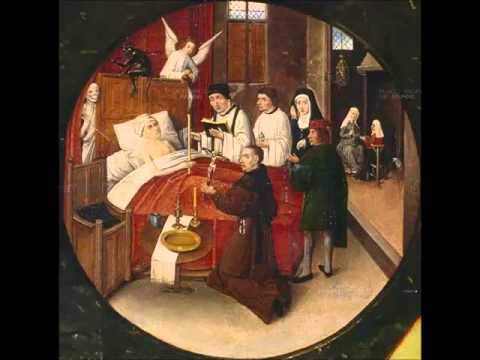
Several of the Fifteen Os also make mention of a particular aspect of discipleship that was especially important in St. Bridget’s time, ending life in faith and trust, having what Jeremy Taylor famously described as “a holy dying.”  As she meditates upon the end of Jesus’ life, St. Bridget is also inviting us, as does the final stanza of one of the Victorian passion hymns, to “Learn of Jesus Christ to die[1]”

In her concern with a holy death, in part St. Bridget reflects the reality of her times.  She was surrounded by people, all of them baptized Christians, who died in unexpected ways every day.  An epidemic struck a village, an army laid siege to a town, a fire swept through a city, and thousands would die.  People lived perilous lives, and unlike the reality in the Western world today, there were very few means of effectively blunting the pain, so that most people were conscious and fully aware of death’s approach. 

Praying the Passion with St. Bridget: Call to Mind

We know that our old self was crucified with him so that the sinful body might be destroyed, and we might no longer be enslaved to sin.  Romans 6:6

In my last meditation, I spoke about the way in which Bridget’s passion prayers carefully turn us away from the danger of viewing Christ’s passion and death as a purely human story.  They also, quite carefully steer us away from the accompanying danger of seeing the Cross as an event that belongs only to the past, something that happened on a lonely hill in Palestine long ago and remains there, an interesting story in someone else’s life.

Instead Bridget believes that Christ’s passion and death are a reality with deep significance for the present moment, and that Christian discipleship is deeply bound up in responding to Christ’s call, described in one of the prayers as “enduring in the way of the Cross.”