The ideology and practice of mass
consumerism reshapes people—their fundamental visions of who and what they
are—not into active citizens but acquisitive consumers. Society itself is transformed not into a rich
network of various sorts of communities and social institutions that together
comprise a civil society that promotes human flourishing, but rather a national
mega-supermarket of endless products and services where shoppers (having been
“empowered” by their incomes) seek human fulfillment through mass
consumption. In such redefined human and
societal realities, things like community life, civic participation and
political engagement become extraneous, almost meaningless. They are reduced to places where the rules of
the market, wealth distribution and product safety and determined. In the end there is no such thing as a common
wealth, a public square, a common good.
All that exists are income-earning workers, commodity producers, service
suppliers, markets, regulation and sites for satiating consumption.” Christian Smith, et. al., Lost in Transition (2011), 217.
Tuesday, September 1, 2015

Monday, August 31, 2015
For Reflection: "As self-centered as I please"
“If I merely tolerate my neighbor
on the assumption that all of us are equal, that means I can take no interest
in the question of which ones of us are right and which ones are wrong; it means
I am denying the community the use of my intelligence and judgment; it means I
am not prepared to defer to those whose abilities are superior to mine, or to
help those whose condition is worse; it means I can be as self-centered as I
please. Wendell Berry, qtd. in Christian Smith, et al. Lost in
Transition, 68.
Sunday, August 30, 2015
Burdens, Freedom and the Heart of the Law
 ‘This people
honors me with their lips, but their heart is far from me.” St. Mark 7:6
‘This people
honors me with their lips, but their heart is far from me.” St. Mark 7:6
When I noticed that today’s Gospel
lesson was about burdensome laws, I had to smile. Because for the last month, my life has been
dominated by one particular burdensome law—Virginia Civil Code 46.2-1177. That’s the law that requires that all Fairfax
County vehicles pass an emissions test prior to registration. Now, in principle, I think it’s a very good
law. I think we have a responsibility to
limit carbon emissions, and I want my kids to breathe clean air, and I’m sure
that auto mechanics do work that contributes to the common good. But in practice—well let’s just say I’ve made
eight trips to Sunset Hills Automotive, and we haven’t passed yet. I’m on a first name basis with everyone in
the shop.
I drive a big old car, which I
inherited from my grandfather. He always
liked a pretty car and this one was his last one and his favorite. Sometimes, when I climb into it, I can still
smell my grandmother’s perfume. I love
the leather seats and the leg room, but the car has reached a certain age, and
apparently its valves, sensors and gas cap appear to be hurtling down the “way
of all flesh.” Over at Sunset Hills,
they test it, and when it fails, they find something wrong and fix that. Then I have to drive it for fifty miles at
varying speeds to reset the monitor and first thing in the morning, they will
test it again. And the process repeats,
and the repair bills rise, and I’m left a rather less enthusiastic environmentalist
than I was when I first moved to Virginia.
All those trips back and forth to the mechanic’s, all that steam being
released from my ears—when you stack up those emissions against the ones
escaping from the minuscule gaps around the sides of my gas cap, I just wonder
how that computes.
Saturday, August 29, 2015
The Anchoress in the Loft
“Happy are they who dwell in your house! * they will always be praising
you.”
Psalm 84:3
“How
did we get a recliner and a coffee table up in the Rood Loft?” I asked Father
Philip. “Oh,” he smiled, “I guess you
haven’t heard the story about our anchoress.”
But let me back up a bit. I was a seminarian at the time, and a member
of the congregation and an altar server at Pusey House. Pusey House is technically not a church, but
a “house of piety and learning,” and it’s the chaplaincy for high-church
Anglican students at Oxford University.
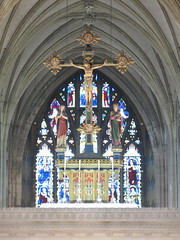
It is housed in a beautiful neo-Gothic chapel, designed by the great
Temple Moore, and the chapel is dominated by a life-size rood, a statue of
Jesus on the Cross with St. Mary and St. John.
The rood is placed on a large platform called the rood-loft, a kind of
balcony that goes across the breadth of the church about ten feet up, dividing
the Chancel of the Church from the Nave.
If you’ve spent much time poking around old churches, you will know the
Rood Screen, which is a smaller version of this—we had one in my last
congregation that was maybe a foot wide.
But the Rood Loft at Pusey House was really a room of its own, 6 or 8
feet wide, with a tall stone parapet on either side. I had been sent up onto it to retrieve some
obscure liturgical implement, and that’s where I discovered the dusty recliner.
The Rood Loft,
Father Philip went on to tell me, had been the home of Pusey’s resident
anchoress for a few months a decade or so before. An anchoress is a person called by God to a
life of solitary prayer. It’s a bit like
a hermit, but while hermits tend to live in caves in the wilderness, anchorites
or anchoresses live inside churches.
Back in the Middle Ages they were quite common, and Julian of Norwich,
the beloved mystic quoted by Rev. Mary Thorpe in her sermon last week, was an
anchoress in the Church of Saint Julian in Norwich back in the fourteenth
century. These days, they are much rarer. In fact, as far as I know, the one from
Pusey’s Rood Loft may have been the only anchoress in the modern history of the
Anglican Communion.
Wednesday, August 5, 2015
God Gave the Growth

“I planted, Apollos watered, but God
gave the growth.” I Cor. 3:6
My family and I were delighted to receive the call from God
to come and join you at Saint Timothy’s.
I look forward to leading you during this time of transition as you say
farewell to Father Brad, and prepare in time to receive the ministry of a new
permanent rector. It has been a special
gift to be able to work alongside Father Brad for nearly a month. It’s lifted a bit of the burden from both of
us, and he has helped me to understand many different ways that God is doing
wonderful things among you.
I can certainly understand why
you have come to love him so much. He is
a man of great compassion and wisdom, and you bear the stamp of his leadership
in many ways (as I’m sure you do also of your associate rectors and those who
lead you before he arrived). Father
Brad’s insistence on God’s love for all people has shaped your active mission
program and gathered together a deeply diverse and open-hearted
congregation. I know that you will all
want to take time in the next few weeks to speak or write to him, thanking him
for the way he has helped you to grow in faith and discipleship. You will also want to spend time praying for
him and his family as he discerns how to continue using his gifts in
retirement.
Tuesday, August 4, 2015
What Do You Crave? A Sermon for Pentecost 10

Exodus
16:4
The manna was a test. Of course, it was a mercy as well. God had led the Israelites into the wilderness of Sinai, a dangerous and desolate place of rocky hills and almost no vegetation. There was no food to be had at all. They had no idea where they were headed. They had only brought what they could gather in a night and carry on their backs. And here in the desert, God was faithful to His promises, and sent them a mysterious food that supplied what they really needed.
But it was a
test. Because every morning the manna
came with the dew, with twice as much on Fridays so they could rest on the
Sabbath. There was no need to work for
it and when kept overnight, it rotted in the pail. So the Israelites had to trust God that He
would send more of it the next day. They
had to rely on His promise that it was enough to keep them in good health and
full strength. They had to be patient
with the lack of variety.
Tuesday, July 28, 2015
Plenteousness: A Sermon for Pentecost 9
 “He
distributed them to those who were seated, so also the fish, as much as they
wanted.”
“He
distributed them to those who were seated, so also the fish, as much as they
wanted.”
St.
John 6:11
It didn’t take us long to see that
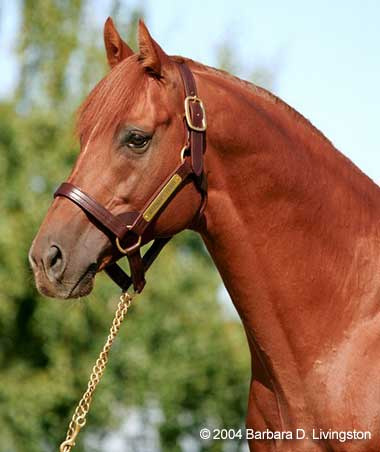
Big Jim wasn’t like any other horse in the barn. He was several hands taller than the quarter
horses, to begin with, and he ate an awful lot more. And he was our only horse with a glorious
past. Big Jim arrived at our small farm
through the auspices of Fred Goody, one of my father’s more eccentric friends.[1] Fred was from the mountains of West Virginia,
and had an astounding number of connections.
Besides Big Jim, he brought us a coon dog and some rather odd pieces of
furniture. You didn’t ask too many questions
about Fred’s procurements, but we were given to understand that Big Jim was a
thoroughbred, who had once been an item on the racetrack at Charles Town. His glory days were behind him, and our place
was the stop that kept him from the glue factory.
For a thoroughbred, Big Jim was a
remarkably calm and good natured animal, and I had no trouble catching him for
his feedings every day. But after he’d
been with us a few months, and had put on a few pounds, we out for a family
ride on a Sunday afternoon. Dad was
riding Big Jim, and we emerged from the woods into a long clearing. Dad wasn’t sure what the signal was, maybe
something the horse heard or the way dad shifted in the saddle. But in an instant, it was as if Big Jim was
rounding the final turn at Charles Town, the crowd cheering and the flags
waving. He sprang into action, his
muscles churning, his neck thrust forward.
None of us had ever seen a horse move like that in our back field. Dad said it was the ride of his life, that it
was like Jim was flying through the air.
He would be leaning back a bit further in the saddle from then on, just
in case Big Jim had a mind to relive old memories again.
Subscribe to:
Posts (Atom)