Showing posts with label liturgy. Show all posts

Monday, February 13, 2017

Public Service Announcement for the Public Service

“Be reconciled with your brother, and then come and offer your gift.”  St. Matthew 5:24

When we gather together as God’s people, our common act is called liturgy.  The word liturgy is taken from the Greek, and like many of the terms we think of as exclusively religious, it originally had a secular meaning.  It means “public service,” and in ancient times, when a ruler or a prominent person would build a bridge or sponsor a series of athletic contests, he might describe it as his liturgy—as an act he had done for the benefit of all. 

Much of our practice of the Christian life is conducted in private.  In our homes, hidden from the world, we pray for the world’s needs and the good of our souls.  At our desks, we read the Bible and decide how we will use our wealth to care for the poor and support the work of the Gospel.  Our faith comes to life when we insist on honesty in the staff meeting at work, or tell our children Bible stories at the bedside, or talk to a friend in distress about how God has helped us through a hard time.

But this work, our common service, is public, for the benefit of all.  The doors are open to everyone.  It is conducted in a large and prominent building, and we fill it with sound, color and movement.  Pastors sometimes call what happens on Sunday morning our “shop window,” the place where our deepest convictions are on display to those who won’t know anything else about our faith and our particular community.  As Jesus reminds us in today’s Gospel, it should flow from our love and care for each other, as people reconciled to God and to one another.

Thursday, February 9, 2017

And with thy Spirit

The substitute priest, so the story goes, was leading the service in an unfamiliar church.  The microphone didn’t seem to be working right, so he paused, looked down toward the contraption and asked, "Is this thing on?"

Hearing no response, he fiddled with the buttons, finally shouting, "Something is wrong with this mic!" In unison, the congregation replies: "And also with you!"

The joke, of course, is based on a truism that regular Sunday worshipers will know well.  If the priest turns to say something to you and you’re not quite sure how to answer, the right response is usually “and also with you”--or maybe, at Saint Francis, “and with thy spirit.”

Tuesday, October 4, 2016

Ponder: "a proper distance is a condition for communion"

"To refuse this silence filled with confident awe and adoration is to refuse God the freedom to capture us by His love and His presence. Sacred silence is therefore the place where we can encounter God, because we come to Him with the proper attitude of a human being who trembles and stands at a distance while hoping confidently. We priests must relearn the filial fear of God and the sacral character of our relations with Him. We must relearn to tremble with astonishment before the Holiness of God and the unprecedented grace of our priesthood.
Silence teaches us a major rule of the spiritual life: familiarity does not foster intimacy; on the contrary, a proper distance is a condition for communion. It is by way of adoration that humanity walks toward love. Sacred silence opens the way to mystical silence, full of loving intimacy. Under the yoke of secular reason, we have forgotten that the sacred and worship are the only entrances to the spiritual life. Therefore I do not hesitate to declare that sacred silence is a cardinal law of all liturgical celebration."
Robert Cardinal Sarah, “CardinalRobert Sarah on the ‘Strength of Silence’ and the Dictatorship of Noise.” The Catholic World Report. 3 Oct 2016.


Wednesday, September 21, 2016

Ponder: "the greatest threat to faith today is not hedonism but distraction"

“And yet our need for quiet has never fully gone away, because our practical achievements, however spectacular, never quite fulfill us. They are always giving way to new wants and needs, always requiring updating or repairing, always falling short. The mania of our online lives reveals this: We keep swiping and swiping because we are never fully satisfied. The late British philosopher Michael Oakeshott starkly called this truth “the deadliness of doing.” There seems no end to this paradox of practical life, and no way out, just an infinite succession of efforts, all doomed ultimately to fail.

Except, of course, there is the option of a spiritual reconciliation to this futility, an attempt to transcend the unending cycle of impermanent human achievement. There is a recognition that beyond mere doing, there is also being; that at the end of life, there is also the great silence of death with which we must eventually make our peace. From the moment I entered a church in my childhood, I understood that this place was different because it was so quiet. The Mass itself was full of silences — those liturgical pauses that would never do in a theater, those minutes of quiet after communion when we were encouraged to get lost in prayer, those liturgical spaces that seemed to insist that we are in no hurry here. And this silence demarcated what we once understood as the sacred, marking a space beyond the secular world of noise and business and shopping.

If the churches came to understand that the greatest threat to faith today is not hedonism but distraction, perhaps they might begin to appeal anew to a frazzled digital generation. Christian leaders seem to think that they need more distraction to counter the distraction. Their services have degenerated into emotional spasms, their spaces drowned with light and noise and locked shut throughout the day, when their darkness and silence might actually draw those whose minds and souls have grown web-weary. But the mysticism of Catholic meditation — of the Rosary, of Benediction, or simple contemplative prayer — is a tradition in search of rediscovery. The monasteries — opened up to more lay visitors — could try to answer to the same needs that the booming yoga movement has increasingly met.”


Andrew Sullivan, “I Used to Be a Human Being.”  New York Magazine.  20 Sep. 2016

Friday, November 27, 2015

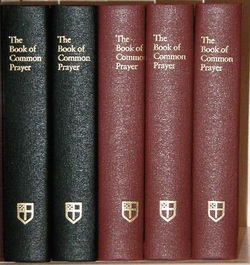
Are we done with the '79 Prayer Book?

Reblogged from Covenant.

After twenty years of pastoral use, we have discovered that, like all its predecessors, it is not a perfect book and could stand some general improvement in some fairly critical places. But I believe the Church has other mission imperatives that require its energy and attention at the present time …. We are nowhere near being finished with what this book is calling us to do. For a variety of reasons, I suspect that most of the Episcopal Church is neither ready to abandon the 1979 prayer book nor willing to commit the time and resources required to replace it. — Neil Alexander, Leaps and Boundaries, pp. 183-184

The Episcopal Church was different in 1997, when these words were penned by Neil Alexander, then a professor of liturgics and preaching at General Theological Seminary. Average Sunday attendance across the church was over a third higher. We had more dioceses, seminaries, and central boards and agencies. There were no Millennium Development Goals. There was a great deal less anxiety about the future. And the cross-marked volume in the pews was still known, fairly universally, as “the new prayer book.”

Sunday, September 20, 2015

Commentary: Four Books of Contemporary Liturgical Theology

From The Living Church, Sept 20, 2015

Within Christ’s sadly fractured body, it has been some consolation for the past few generations that at least the liturgists could sing from the same hymnal.  The convictions and priorities of the Liturgical Movement have reshaped the Sunday gatherings of most Christians across the Western world, drawing us together through the use of shared texts, calendars and lectionaries, as well as a common emphasis on active lay participation. 

The Second Vatican Council’s liturgical reforms reclaimed the centrality of baptism, simplified ceremonial and symbolism and exalted early Christian liturgies as a model for contemporary use.  The Roman Catholic Church’s revised liturgies, which debuted fifty years ago decisively shaped a wave of new liturgical resources throughout mainline Protestantism, including the Episcopal Church’s Book of Common Prayer (1979).  With perhaps the sole exception of biblical studies among the other theological disciplines, liturgical scholars have been educated together and continued in dialogue across confessional borders, working together to institute change within their respective church bodies. 

But that longstanding consensus is clearly beginning to fray.  The grand promises about reformed liturgy’s capacity to reenergize Christian mission and catechesis have worn thin in the advancing days of secularism.  Historical scholarship has undermined earlier confidence about unified patterns of liturgy within the early Church.  Texts, music, and aesthetic idioms that were exciting and innovative 50 years ago now largely seem banal and gauche.   Roman Catholicism’s most recent liturgical developments have been oriented toward reclaiming Latinity, while mainline Protestants have consistently pushed the envelope in the direction of inclusivity, stressing pastoral concerns.  Evangelicalism’s relative growth has popularized casual and emotive forms of worship untouched by the Liturgical Movement’s influence.