Monday, June 6, 2016

Speaking across the gap

He cried out to the Lord, "O Lord my God, have you brought calamity even upon the widow with whom I am staying, by killing her son?"  I Kings 17:20

For me, the biggest surprise of my trip to Zambia in April was having dinner with the Archbishop of Canterbury.  It wasn’t at all planned.  I’d been given a banquet ticket at the last minute, and when the waiter went looking for a seat for me, it was the first one he spotted, right at the front, beside the spiritual head of the world’s 85 million Anglicans.

I was delighted, of course.  I am a great admirer of Archbishop Welby’s.  I pray for him every morning, and I believe that God has given him to us as the leader we need at this challenging time.  Given a few days’ notice, I could have formulated any number of appropriate anecdotes for a casual evening or profound questions for an interview.  But I was not prepared, on a few seconds’ notice to make small talk to him for an hour or so.

I wasn’t really afraid I would use the wrong fork or the wrong title.  It was dark enough to conceal the flatware and the menu was traditional Zambian.  I’m not sure that the archbishop knew how to spear pan-fried caterpillars any better than I did.

Sunday, June 5, 2016

Stirring up the gift of preaching

From "The WORD," St. Timothy's, Herndon, June, 2016.

“Preach the word, be urgent in season and out of season, convince, rebuke, and exhort, be unfailing in patience and in teaching.”  II Tim 4:2

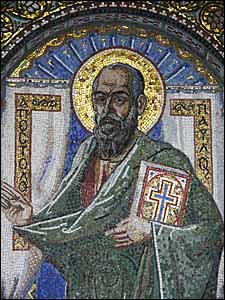
I have been reading through Saint Paul’s Epistles to Timothy over the last week at Morning Prayer, and I’ve been struck by how often they discuss preaching.  Together with the Epistle to Titus, scholars call them the “Pastoral Epistles.”  They are essentially letters of advice from a senior church leader, St. Paul, to his beloved junior colleague.  

Paul had prepared Timothy, over many years, for his ministry as a bishop.  He had shared the good news about Jesus with him, and showed him how to teach and encourage different kinds of people.  He had watched Paul deal with controversies and broker agreements.  Paul had watched over Timothy, tested him to know his suitability, and he had sent him off with prayer, trusting steadfastly in the Holy Spirit. 

But now that Timothy had been engaged in his ministry for a few years, some further instruction was necessary.  And a great deal of that instruction focused on preaching.  Some of Paul’s advice is about the content of the Christian message and how it relates to other dangerous ideas.  Some of the advice is about adapting the message to different kinds of audiences, who bring different spiritual needs to the weekly gathering for worship.  A fair amount of it is simply encouragement and exhortation, as Paul urges Timothy to remember just how important preaching really is, and to always be earnest in presenting his case, “in season and out of season.”

Saturday, June 4, 2016

Ponder: "suddenly stripped clean of everything that once seemed so important"

“So then, Charlie was to receive the last rites in full: he would be anointed, he would make his confession, he would receive Holy Communion—the old ritual that sees us from this world.  And as I watched the Franciscan go up the stairs, led by Helen, who was holding the prescribed lighted candle, and followed by the young doctor, once more I was almost overcome by the special feeling of this moment, this profound and unique movement that is like no other in time, this moment that is suddenly stripped clean of everything that once seemed so important, and in which nothing now matters but the limitless mercy of God.”


Edwin O’Connor, The Edge of Sadness

Friday, June 3, 2016

Ponder: "we all share in shattering duality"

“The great mistake, I think, the mistake that surely leads to more misery, is for the victim to succumb to the normal temptation and take the part for the whole.  For there is a balance here: the great majority of those who winked and nudged and raved and joked would, in the very next moment, have willingly given me whatever lift they could, and the same schoolboy who staggered with such derisive exactness would in an instant have given up his free morning to serve my Mass and drive me halfway across the state and back.  We all share in shattering duality—and by this I don’t mean that soggy, superficial split that one so often sees: the kind of thing, for example, where the gangster sobs uncontrollably at an old Shirley Temple movie.  I mean the fundamental schism that Newman referred to when he spoke of man being forever involved in the consequences of some “terrible, aboriginal calamity;” every day in every man there is this warfare of the parts.  And while all this results in meanness and bitterness and savagery enough, God knows, and while only a fool can look around him and smile serenely in unwatered optimism, nevertheless  the wonder of it all is to me the frequency with which kindness, the essential goodness of man does break through, and as one who has received his full measure of that goodness, I can say that for me, at least, it is in the long succession of these small, redemptive instants, just as much as in the magnificence of heroes, that the meaning and the glory of man is revealed.”


Edwin O’Connor, The Edge of Sadness

Thursday, June 2, 2016

Ponder: "the carnival shill approach to the church"

“I’ve always disliked and mistrusted this carnival shill approach to the church—and yet heaven knows we see it often enough.  Does it really work?  I don’t think so, but more than that I think it’s all wrong.  Because for one thing it’s so unworthy.  I don’t mean by this that it’s too informal, too much in the marketplace, too “popular;” I do mean, quite simply, that it’s cheap.

Obviously, when you talk about such things as God, religion, the church, man’s soul, to a great many different people, you much necessarily do so in a great many different ways and on a great many different levels.  But none of these levels can be—or at least none of them should be—in any sense flashy or false or vulgar, because if they are—no matter what the apparent justification—you run the very serious risk of making God, religion, the church, and man’s soul seem just a little bit of the same.  It’s all very well to suggest that this really doesn’t matter so much, that what does matter is that, as a result, the people come in, but I think that’s a great mistake.  I know they come in—and often in considerable numbers—in response to such techniques.  That’s not surprising. 

Ponder: "Call the church to faith; do not throw her away."

"Your first charge is to remember that the occupation [of the world by the Evil One] itself is really a fraud. The Devil is a lie, not a power. God is in fact now the owner of all things, including our culture, including our church. Hence, the Church cannot be false in itself, although it can sin horrendously. The Church is Israel: “not my people” becoming “my people” in the power and promises of God (Hosea 1:9, 2:23; Rom. 9:25-6). I am more convinced of this than I was 13 years ago, when everything exploded in the Anglican Communion. Israel: at times focused, at times dispersed; sometimes entranced, sometimes suicidal; fervent, disobedient, and blasphemous. Israel, the Church, exists by the continuous promises of God and by God’s deliberate ordering, including his justice and mercy. Call the Church to faith; do not throw her away."

Ephraim Radner, Ministry in Enemy-Occupied Territory, Covenant 2 June 2016

For Meditation: "trust God's present power"

"Trust. We often use “trust” as a synonym for “faith”, but it isn’t really. “Trust” is a strange English word, originating from words meaning encouragement and the cheering of others. Then the word “trust” came to connote a kind of intimacy and sharing, and only last did it come to connote a certain reliance. In a way, the word “trust” combines all three of the theological virtues: faith, hope, and love together. Trust is bound up with the One who comes close, holds on to us, fills us with cheer.

Ministers who trust, as I charge you to be — who trust God, and trust God’s life in Christ, and trust God’s present power in Christ’s death, resurrection, and ascension — such trusters are precisely those who can know that the Church is God’s, and who can be obedient: Who can stop counting. Who can just follow. Who do not lose hope. Who can “let goodness happen” amid the lies of the occupiers. Because only God is good, as Jesus says (Mark 10:18), goodness is therefore sovereign — utterly, sheerly, magnificently."

Ephraim Radner, Ministry in Enemy-Occupied Territory, Covenant 2 June 2016,