Sunday, May 28, 2017

Sharing His Glory

All mine are thine, and thine are mine, and I am glorified in them.  St. John 17:10

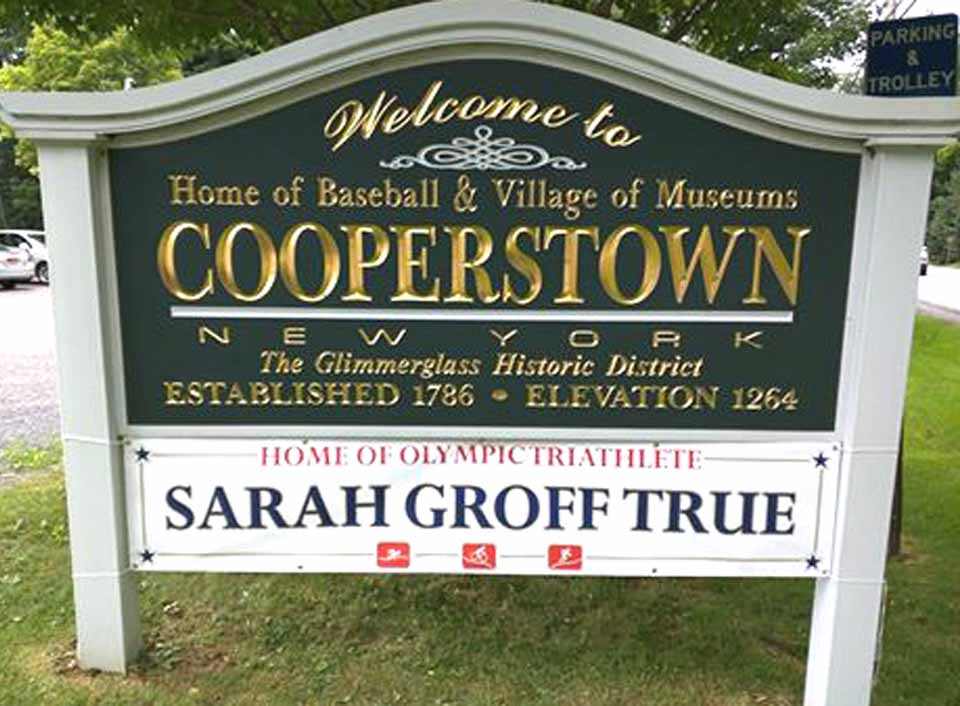
For a few days back in 2012, everyone in Cooperstown, New York had Olympic fever.  Team USA banners hung in all the shop windows, people wore Olympic buttons on their lapels.  The Chamber of Commerce sponsored a watch party and there were drink specials in the local bar. 

We were all so excited because Sarah True, one of our own, was going for the gold.  Sarah was then America’s leading triathlete, and she had grown up in our village of 2000 souls.  Her parents still live in town, working at the local hospital.  Sarah had swum across the Lake on the edge of the village when she was 14, and competed on the high school track team.  Her old coaches and babysitters could remember how it was when she was just so tall.  

In the end Sarah finished fourth, ten seconds short of a medal.  But when she finally made it home, we paraded her down Main Street as a hero, with firetrucks and the high school band, proud as could be that one of our own had achieved something so incredible. 

Behind our excitement was a sense that Sarah was carrying a little of all of us into her great moment before the eyes of the world.  Some people felt they had helped to form her for this moment, for others her triumph was showing us just what could be possible for a kid from a little town in upstate New York.  We had a little share in her glory, and for one unique moment, that was a thrilling thing.

Thursday, May 18, 2017

The 'Bounds of Habitation' and the Whitetail Invasion

From my In the Sound of the Bells column in the May 11 issue of The Potomac Almanac.

After last week’s spot of yardwork, I feel like a real permanent resident of Potomac.  I now have a deer fence.  A “heavy duty” deer fence, to be precise, no mere agglomeration of netting and iron stakes, but a 7.5-foot-tall fence, its posts sunk deep into the ground, bound by high tensile wire top and bottom, staked every foot into the ground. 

I’ve been wanting to plant a raspberry patch for years, and we identified a great spot in the backyard.  I researched the varieties I wanted to use and worked out a plan for a raised bed.  But if it would all be for naught if I didn’t find a reliable way to keep out the local wildlife, if the saucy, bovine creatures that saunter through our yard and the woods around us really deserve the name. 

Wednesday, May 10, 2017

Praying, Not Electioneering


Last Thursday was the National Day of Prayer. US Presidents have designated days of prayer, fasting and thanksgiving since the very beginning of our republic.  Our earlier prayer books had liturgical forms for these occasions, which were once quite prominent and numerous.  The National Day of Prayer, as an annual, recurring spring event is relatively modern, though.  It was resolved by Congress in 1952, in the dark days of the Korean War, at the urgent prompting of then young and dynamic evangelist, Billy Graham.

Prayer services for our nation and its leaders are held across the country on this day, including sometimes in the White House and on Capitol Hill.  I’ve participated in at least one ecumenical service for the day, and at Evening Prayer last Thursday at Saint Francis, we included a petition for the President and the Congress, nodding to the occasion.  Our leaders need our prayers, especially at times of great change.  It’s surely a good thing to gather people of different creeds and traditions to ask God for wisdom and courage for those who face such daunting challenges.

But this year’s National Day of Prayer will be remembered for something else as well.  At the White House event marking the occasion, President Trump announced his decision to sign an executive order directing the IRS not to enforce the Johnson Amendment, part of the US Tax Code.  The amendment is nearly as old as the Day of Prayer itself, having been authored by then-senator Lyndon B. Johnson in 1954.  It also reflects a time when religion had a more prominent role in American public life.  The amendment essentially says that churches, like other non-profit organizations, risk losing their tax-exempt status if they endorse political candidates. 

By a stroke of the pen, President Trump has given a wide berth for American religious institutions to dramatically expand their involvement in the political system.  To my mind, that’s a very bad thing. 

Wednesday, May 3, 2017

To Make Something Good Together in the World

From The Potomac Almanac, 30 Mar. 2017 (and The Sounds of St. Francis, 3 May)

Shortly after we moved to Potomac, our eldest son joined the local Cub Scout pack, 773, which is sponsored by Potomac United Methodist Church.  The pack our son had joined near our former home in Virginia was newly established, with just a handful of kids and a rather harried group of parent volunteers always scrambling to pull things together.  It’s been exciting to be part of a much larger pack here, with a really talented and committed group of leaders and an impressive variety of activities.

We were expecting that the Pinewood Derby at the pack here in Potomac would be pretty special.  But nothing we had seen yet quite prepared us for the event that unfolded a few Saturdays ago in the United Methodist Church’s Parish Center. 

The Pinewood Derby isn’t quite as old as scouting itself, but it goes back over sixty years, when a scoutmaster in California decided that his charges weren’t quite ready for the then common project of constructing cars out of soapboxes to ride in down a hill themselves (these were the days before soap came in plastic wrap and people worried much about liability insurance).  The scoutmaster’s idea was to have the boys to whittle or cut a car out of a small piece of pine, to nail on some simple wheels, and then to race the cars down an inclined track.

Sunday, April 16, 2017

Taking Easter Home


“Behold, he goeth before you into Galilee; there shall ye see him.”  St. Matthew 28:7

One of the special things about settling in the DC area for Allison and me is spending time in the city where we fell in love.  Back in the summer of 2003, I had just finished my studies at seminary and was getting ready to begin as a teacher at a boarding school near Hagerstown.  Allison was a public policy student completing her mandatory student internship at a organization on Capitol Hill.  I’d meet her after work in the grand hall of Union Station and we’d head off to one of those free concerts at the Kennedy Center or we’d sit and talk in one of those pleasant little parks near the Capitol, or share a meal in that most exotic and romantic locale, the food court in the basement of the train station.

Sometimes, when we’ve got the kids in the backseat and we’re headed off to a museum on the Mall or to see a friend who lives across town, we’ll drive by one of these places and tell them a little about what it meant to us then.   So much that has happened since then that we never expected, but many of the good things we do enjoy now were planted there.  Going back to those places, we fall in love again, or at least we understand something valuable about the love we share now, something we can only discover there, where it all began.

Thursday, April 13, 2017

It Would Have Been Enough

“Having loved his own who were in the world, he loved them to the end.”  St. John 13:1

Maybe you saw the article in the Washington Post last week about matzoh man’s visit to Farragut Park[1].  Maybe, at least, you remember the unforgettable picture.  Matzoh Man is a rabbi, Shmuel Herzfeld of Synagouge Ohev Sholom in Northwest.  About this time every year he dresses in his matzoh suit and kippah, which are white with brown spots.  He revs up the matzoh mobile, a Crown Vic wrapped in a vinyl coating that makes it look like the ubiquitous Jewish cracker. 

And he drives downtown to pass out boxes of the unleavened bread, all the while wishing people a happy Passover and reminding Jews to keep the Seder at home this year.  He’s ready to give you the matzoh you need, to invite you to the community seder at his synagogue, to do everything he can to awaken the consciousness of America’s increasingly secular Jews to remember their ancient traditions and to celebrate God’s faithfulness once more this year.

The Post reporter, who was obviously having a great time with the article, asked rabbi Herzfeld why he does it.  And as I was reading, I thought to myself: “this guy is going to say he was a performance artist in his former life, or that he finished last in the rabbinical council’s fantasy football pool.”  Why else would a well-educated, successful religious leader go downtown dressed like a Saltine to shame his fellow Jews into keeping the Seder. 

Wednesday, April 12, 2017

Homage for Our True King

From the Sounds of St. Francis, 13 April 2017

I know that several of you, like me, enjoyed watching the recent Netflix miniseries, The Crown.  For me, one of the most moving scenes was Elizabeth’s coronation in Westminster Abbey at the close of the fifth episode, an event whose planning had consumed a good deal of the dramatic tension in the several episodes preceding it.  The Netflix series faithfully rendered the grand music, solemn ritual and stunning costumes of the ceremony. 

It also showed part of the homage, the ancient ceremony that follows the anointing and crowning of the monarch.  The senior nobles of the kingdom, the “lords of the realm,” (Prince Philip notably among them) knelt before the new queen to speak an oath and kiss her hand.  The words of the oath at the homage (not includes in the series script, if I remember correctly), are these: “I do become your liege man of life and limb, and of earthly worship; and faith and truth I will bear unto you, to live and die, against all manner of folks.  So help me God.”

The oath is a promise of deep loyalty.  The act of kneeling expresses respect, even a kind of reverence for the monarchy and its place in the life of the nation.  And the kiss is a token of affection, a sign that the promise is made freely, with the whole heart.