Showing posts with label patience. Show all posts

Thursday, August 3, 2017

Zeal and Patience, Part II


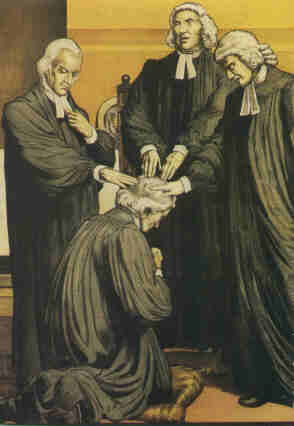
As the Episcopal and United Methodist churches consider a full-communion agreement, this article continues the story of the zealous John Wesley and  the patient Samuel Seabury, the founders of the two churches.  It outlines a missed opportunity for a united church in 1784, and what the failure then may still be able to teach us today.  The article was first published on The Living Church's Covenant blog on 12 July
As Wesley sent off his letter, and Thomas Coke with it to come to America with the purpose of ordaining his preachers, another Anglican priest was also travelling about Britain. Samuel Seabury, bishop-elect of Connecticut, was pursuing a different potential solution to American Anglicanism’s pastoral crisis, one he believed to be essential to “follow[ing] the Scriptures and the Primitive Church.” Seabury was in search of three bishops who would consecrate him, so that episcopacy might be carried back to his native land.
Seabury’s zeal in pursuit of his cause cannot be doubted, but he was above all a patientman. For nearly a year and a half, he met with a number of English bishops to plead his case, some of them multiple times. Like Wesley, he was rather woodenly rebuffed by Robert Lowth, the Bishop of London, who could not imagine the prospect of consecrating a bishop who lacked a warrant from the Connecticut state legislature. Some of Seabury’s countrymen were using their personal contacts to work against his case, including the bishop-elect of Maryland, William Smith, who distrusted Seabury because he had been a loyalist. Deeply frustrated by delays and inconclusive answers, Seabury wrote to a fellow Connecticut clergyman, “I shall be at my wits’ end. … This is certainly the worst country in the world to do business in” (Letter to Abraham Jarvis).


Sunday, May 28, 2017

Sharing His Glory

All mine are thine, and thine are mine, and I am glorified in them.  St. John 17:10

For a few days back in 2012, everyone in Cooperstown, New York had Olympic fever.  Team USA banners hung in all the shop windows, people wore Olympic buttons on their lapels.  The Chamber of Commerce sponsored a watch party and there were drink specials in the local bar. 

We were all so excited because Sarah True, one of our own, was going for the gold.  Sarah was then America’s leading triathlete, and she had grown up in our village of 2000 souls.  Her parents still live in town, working at the local hospital.  Sarah had swum across the Lake on the edge of the village when she was 14, and competed on the high school track team.  Her old coaches and babysitters could remember how it was when she was just so tall.  

In the end Sarah finished fourth, ten seconds short of a medal.  But when she finally made it home, we paraded her down Main Street as a hero, with firetrucks and the high school band, proud as could be that one of our own had achieved something so incredible. 

Behind our excitement was a sense that Sarah was carrying a little of all of us into her great moment before the eyes of the world.  Some people felt they had helped to form her for this moment, for others her triumph was showing us just what could be possible for a kid from a little town in upstate New York.  We had a little share in her glory, and for one unique moment, that was a thrilling thing.

Sunday, April 16, 2017

Taking Easter Home


“Behold, he goeth before you into Galilee; there shall ye see him.”  St. Matthew 28:7

One of the special things about settling in the DC area for Allison and me is spending time in the city where we fell in love.  Back in the summer of 2003, I had just finished my studies at seminary and was getting ready to begin as a teacher at a boarding school near Hagerstown.  Allison was a public policy student completing her mandatory student internship at a organization on Capitol Hill.  I’d meet her after work in the grand hall of Union Station and we’d head off to one of those free concerts at the Kennedy Center or we’d sit and talk in one of those pleasant little parks near the Capitol, or share a meal in that most exotic and romantic locale, the food court in the basement of the train station.

Sometimes, when we’ve got the kids in the backseat and we’re headed off to a museum on the Mall or to see a friend who lives across town, we’ll drive by one of these places and tell them a little about what it meant to us then.   So much that has happened since then that we never expected, but many of the good things we do enjoy now were planted there.  Going back to those places, we fall in love again, or at least we understand something valuable about the love we share now, something we can only discover there, where it all began.

Thursday, March 30, 2017

Ponder: "a good servant for the soul"

“The more we shun suffering, the more we come under its thrall, we become its slave.  To seek it, or at least to endure it, and to love it not for its own sake but for the sake of the good things that may be wrought through it, that is to become its master. Suffering that is such a bad master makes a good slave, a good servant for the soul in love with Jesus Crucified.”

Vincent McNabb, OP, The Craft of Suffering (1936), 73.

Sunday, March 5, 2017

A Place in the Order of Things

My grandfather died two weeks ago, a few months short of his 89th birthday, in the same room where he was born. Most every night of his long life, he slept under the same roof, in the farmhouse where his parents had settled just after their marriage.

Historically speaking, this kind of stability is unremarkable. But in modern America, where the average person moves 11.4 times in a lifetime, it would be difficult to compute just how rare it is. My eldest son, who just turned eight, has already lived in four different homes, in three different states.

My grandfather also died a farmer, as had his father before him, and his grandfather before him, back as far as the records go. We tucked wheat stalks and an ear of field corn into the floral spray on his coffin. The photos lined up at the back of the funeral home showed him on his tractor and standing in the barnyard with the Angus steers. There was a sign from Esskay, which bought his beef for decades, and an aerial photo of the farm.

He’d only foresworn the tractor two years ago, when a fall from the step landed him in the hospital for a few weeks. He continued to supervise the work done by others and to check the grain prices regularly. I saw him in the hospital a few days before his death, when the medicine was making his mind a bit foggier than usual. He looked out his window over a vast parking lot, but what he saw was a rolling field. “That one would be good for corn,” he told me.

Thursday, December 15, 2016

Ponder:"to wait is a distinct kind of activity"

"A new aspect of the eucharist comes to life when we think of it as a sign that we are waiting for the day of the Lord’s return. To wait is a quite distinct kind of activity. It means recognizing that someone else is the prime mover or principal actor. It means admitting that we ourselves are in secondary roles, so secondary that we do not know the time schedule. It means living in patience and hope. This is the spirit of much of the Bible, especially of the Psalms which are such a regular part of traditional public and private prayer. This is the spirit in which the New Testament speaks of breaking the bread and drinking the cup until the Lord comes."
H. Boone Porter, "The End of Advent"  Covenant, 15 Dec. 2016

Sunday, September 18, 2016

Ponder: unselfishness, the sign of God's kingdom

"Dorothy Day wrote, 'Patience, patience--which means suffering.' Her life of sacrificial service to the poor was one of great power that places her in the first rank of Christians who will be remembered...Dorothy Day's commitment to a sacrificial life arose from a place of strength, not a place of weakness.  Such a life, rightly understood, is uniquely empowering because it is aligned with the self-giving of God in Christ.  Wherever there are gracious acts of unselfishness, there are the signs of God's kingdom of remade relationships based on mutual self-offering.

Fleming Rutledge, The Crucifixion (2014), 275.

Monday, August 29, 2016

Hidden angels

“Do not neglect to show hospitality to strangers, for by doing that some have entertained angels without knowing it.”  Hebrews 13:2

Frank[1] drank his coffee strong and black, and he liked bacon hot from the pan.  He was indifferent when it came to fried eggs and couldn’t quite see the point of buttered toast. 
I learned the menu well for Frank’s annual visit when I was the rector in Cooperstown, New York.  In Cooperstown, we had what we called “the August people,” who head out from New York and Boston to escape the late summer heat beside our shimmering lake.  Frank was one of them, coming every year for a day or two when August turns into September.  Unlike those other August people, who spent the night between the fine linen sheets of the Otesaga Hotel, Frank bedded down on the couch in Saint Agnes Chapel.
Frank, you see, was a hobo. 

Tuesday, June 21, 2016

Ponder: "by his patience, laid low the cruel one"

"Thus blessed Job, when stricken with the loss of his substance and with the death of his children, forasmuch as he turned the force of his anguish into praise of his Creator, exclaiming The Lord gave and the Lord taketh away; as it hath pleased the Lord, so is it done; blessed be the Name of the Lord: by his humility, struck down the enemy in his pride, and by his patience, laid low the cruel one.  Let us never imagine that our combatant received wounds and yet inflicted none.  For whatever words of patience he gave forth to the praise of God, when he was stricken, he as it were hurled so many darts into the breast of his adversary, and inflicted much sorer wounds than he underwent, for by his affliction he lost the things of earth, but by bearing his affliction with humility, he multiplied his heavenly blessings."
Gregory the Great, Morals in Job, II.21

Tuesday, February 23, 2016

Ponder: capable of imagining the loves of strangers

All these cases are illustrations of the central, familiar, moral insight of the book.  "If you can learn a simple trick, Scout," Atticus advises his daughter, "you'll get along a lot better with all kinds of folks.  You never really understand a person until you consider things from his point of view...-until you climb into his skin and walk around in it."

For Lee, this point demands more than observation.  By actively treating people as individuals, they can respond with unexpected virtue.  In the book, Walter Cunningham is part of a lynch mob.  When Scout causes Cunningham to recall that he is a father, he walks away from violence.  Men and women can be better than the mob, when they remember their hidden dignity, their secret honor.  Lee defends the possibility of the awakened conscience.

Right now, the world of adults seems increasingly like Lee's Maycomb, with a tiny religious minority stigmatized and targeted for exclusion, and another minority being accused of being criminals and rapists, demonstrating the strangely sexual content of bigotry.  And though we now it is not quite right, there are few who can manage tears.  

Once again--maybe always--there is a great drama in what Lee called "the secret courts of men's hearts."  Let us hope with Lee that people are better than the mob and capable of imagining the loves of strangers.  And whatever the outcome, Atticus--more real than any living politician--urges us to see it through.
Michael Gerson, "Timely Insights from 'Mockingbird'" The Washington Post 23 Feb 2016, A17

The faith in the waiting


“But he said, "O Lord GOD, how am I to know that I shall possess it?"”  Genesis 15:8

Abram had learned to wait.  God had spoken to him powerfully, when he was a man in the prime of life, living in the great Mesopotamian city of Ur.  “"Go from your country and your kindred and your father's house to the land that I will show you.[1]”  And he had gone, following this strange God and his lavish promises. God told him of an abundant land.  He promised wealth.  And most poignantly, he told of a multitude of descendants.  Abram would be the father of a great nation. 

God had spoken to him once more, when his protégé, Lot had set off to make his own way in the world.  Again, there were the same promises, the assurance that God would be faithful.  That was decades ago, though.  Abram amassed cattle and slaves, he dabbled in politics, he became an elder statesman among the tribes of the Palestinian desert. He’d just been through a rather fierce battle, which has a way of clarifying your perspective, I’m told.  But still there were no children.

And Abram was tired of waiting. 

Friday, February 5, 2016

Ponder: "not attempting to improve it, they never desecrated it"

"In the working of silver or drilling of turquoise the Indians had exhaustless patience; upon their blankets and belts and ceremonial robes they lavished their skill and pains.  They had none of the European's desire to 'master' nature, to arrange and re-create.  They spent their ingenuity in the opposite direction; in accommodating themselves to the scene in which they found themselves.  This was not so much from indolence, the Bishop thought, as from an inherited caution and respect.  It was as if the great country were asleep and they wished to carry on their lives without awakening it; or as if the spirits of earth and air and water were things to not antagonize and arouse.  When they hunted, it was with the same discretion; an Indian hunt was never a slaughter.  They ravaged neither the rivers nor the forest, and if they irrigated, they took as little water as would serve their needs.  The land and all that it bore, they treated with consideration; not attempting to improve it, they never desecrated it."
Willa Cather, Death Comes to the Archbishop, 233-234

Friday, November 27, 2015

Are we done with the '79 Prayer Book?

Reblogged from Covenant.

After twenty years of pastoral use, we have discovered that, like all its predecessors, it is not a perfect book and could stand some general improvement in some fairly critical places. But I believe the Church has other mission imperatives that require its energy and attention at the present time …. We are nowhere near being finished with what this book is calling us to do. For a variety of reasons, I suspect that most of the Episcopal Church is neither ready to abandon the 1979 prayer book nor willing to commit the time and resources required to replace it. — Neil Alexander, Leaps and Boundaries, pp. 183-184

The Episcopal Church was different in 1997, when these words were penned by Neil Alexander, then a professor of liturgics and preaching at General Theological Seminary. Average Sunday attendance across the church was over a third higher. We had more dioceses, seminaries, and central boards and agencies. There were no Millennium Development Goals. There was a great deal less anxiety about the future. And the cross-marked volume in the pews was still known, fairly universally, as “the new prayer book.”

Tuesday, June 23, 2015

It's Not All About You: CCS Baccalaureate Sermon

 
“But Jesus answered, "You do not know what you are asking. Are you able to drink the cup that I am to drink?" They said to him, "We are able."  St. Matthew 20:22

In the Name of the Father, and of the Son, and of the Holy Spirit, Amen.

You know, this really isn’t all about you.  This grand succession of banquets, awards ceremonies, sunshiny photo-ops, and sentimental speeches, all the parties, everything festooned in orange and black—it’s not really all about you.  It is of course, largely about you.  You have worked very hard, and achieved a great deal, and there is much to celebrate as you are commenced, launched out into the big world beyond these quiet hills. 

 But this is about the rest of us as well, your parents and teachers, your friends who have watched you grow up into such intelligent, strong, and capable men and women.  If you haven’t recognized this yet, you will after that tenth awkward photo with your strange aunt Sue, and seventh time your rather formidable social studies teacher gets teary-eyed.  And let’s not even think about your mother’s emotional state next Sunday afternoon. 

Wednesday, May 13, 2015

For Meditation: Tarrying His Leisure

From my morning reading, Hughson's With Christ in God:

Though we must serve God with a generous spirit, care must be taken lest we mar our service by over-eagerness and impetuosity.  There is always time enough and strength enough to accomplish the divine will, and many a soul has been led into sin by an over-eagerness to do something for God.  The prudent soul does nothing with precipitancy.  The working of the gift of counsel fills us with a spirit of patience, of calm, which indicates that we know the strength of God is our own.  We are willing to tarry the Lord's leisure.  Our faith in Him  will permit of no apprehension of failure.  (326).