Showing posts with label ecumenism. Show all posts

Wednesday, August 16, 2017

Zeal and Patience, Part IV

Originally published on Covenant, 19 July, 2017
A similar uncertainty surrounds the affirmations about our essential unity of belief regarding the Holy Eucharist. It is true that This Holy Mystery: A United Methodist Understanding of Holy Communion affirms “the real, personal, and living presence of Jesus” in the sacramental elements (though “in temporal and relational terms”). However, assorted practices surrounding the celebration and administration of Holy Communion in United Methodist Churches stand at some tension with this claim, as they deviate so seriously from historical norms.
Much of the online discussion has centered on whether the Methodist requirement that Holy Communion be celebrated with “the pure, unfermented juice of the grape” can be squared with the Chicago-Lambeth Quadrilateral’s that the Holy Communion be “ministered with unfailing use of Christ’s words of institution and of the elements ordained by Him.” More serious is the nearly universal United Methodist practice of admitting the unbaptized to Communion and the widespread authorization for celebrating Holy Communion by licensed local (unordained) pastors.

Thursday, August 3, 2017

Zeal and Patience, Part II


As the Episcopal and United Methodist churches consider a full-communion agreement, this article continues the story of the zealous John Wesley and  the patient Samuel Seabury, the founders of the two churches.  It outlines a missed opportunity for a united church in 1784, and what the failure then may still be able to teach us today.  The article was first published on The Living Church's Covenant blog on 12 July
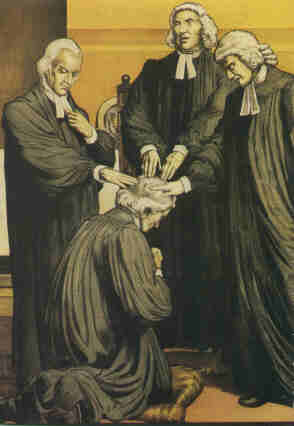
As Wesley sent off his letter, and Thomas Coke with it to come to America with the purpose of ordaining his preachers, another Anglican priest was also travelling about Britain. Samuel Seabury, bishop-elect of Connecticut, was pursuing a different potential solution to American Anglicanism’s pastoral crisis, one he believed to be essential to “follow[ing] the Scriptures and the Primitive Church.” Seabury was in search of three bishops who would consecrate him, so that episcopacy might be carried back to his native land.
Seabury’s zeal in pursuit of his cause cannot be doubted, but he was above all a patientman. For nearly a year and a half, he met with a number of English bishops to plead his case, some of them multiple times. Like Wesley, he was rather woodenly rebuffed by Robert Lowth, the Bishop of London, who could not imagine the prospect of consecrating a bishop who lacked a warrant from the Connecticut state legislature. Some of Seabury’s countrymen were using their personal contacts to work against his case, including the bishop-elect of Maryland, William Smith, who distrusted Seabury because he had been a loyalist. Deeply frustrated by delays and inconclusive answers, Seabury wrote to a fellow Connecticut clergyman, “I shall be at my wits’ end. … This is certainly the worst country in the world to do business in” (Letter to Abraham Jarvis).

Thursday, April 14, 2016

ACC Hears Glad Tidings

from The Living Church 14 Apr. 2016

LUSAKA, Zambia — The Anglican Consultative Council has considered new ecumenical agreements with Methodist, Orthodox, and the Oriental Orthodox churches as well as theological work seeking to unify the Instruments of Communion
.
The Rev. Canon John Gibaut, the Anglican Communion’s Director for Unity, Faith, and Order, presented several statements for approval to the delegates April 13. The statements had been prepared under the supervision of the Inter-Anglican Standing Commission on Unity, Faith, and Order (IASCUFO), the Communion-wide team of 25 theologians responsible for doctrinal and ecumenical work.

For Anglicans, Gibaut said, the search for Christian unity is central to the practice of discipleship. He finds, though, in his conversations with ordinary Anglicans that many seem to confuse unity with uniformity or conformity.