Showing posts with label martyrdom. Show all posts

Monday, October 23, 2017

Rendering to God

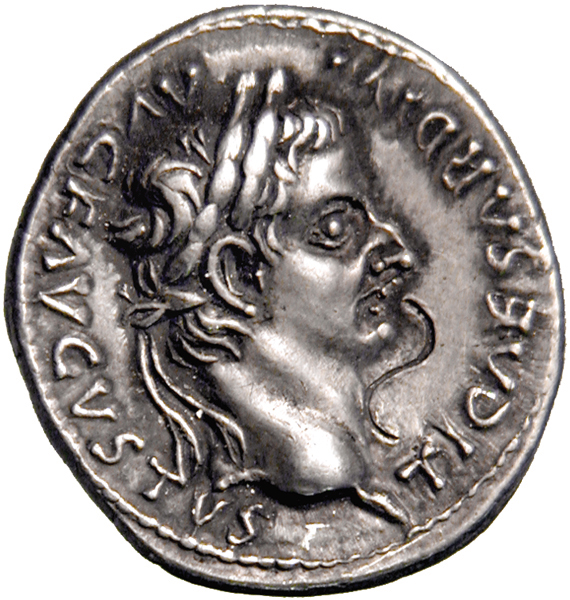
“Render therefore to Caesar the things that are Caesar’s, and to God the things that are God’s.”  St. Matthew 22:21

It was quietly noted a few weeks ago that Treasury Secretary Steve Mnuchin has declined to endorse an Obama administration plan to put Harriet Tubman on the $20 bill.  His predecessor, Jacob Lew, saw honoring the great antislavery hero as the first step in redressing a historic imbalance in the way we have honored national heroes.  The $20 bill was a convenient place to start, as Andrew Jackson has come under fire in recent years for his slaveholding and for his decision to forcibly remove Indians to the West along the infamous Trail of Tears.   

But Andrew Jackson also happens to be one of President Trump’s personal heroes.  The President honors Jackson as a brave soldier, and a symbol of democracy, the first true man of the people to be elected to our nation’s highest office.  The president laid a wreath at Jackson’s tomb as part of the 250th anniversary celebration of his birth and has hung a painting of him in the Oval Office.[1]  You can be sure that Old Hickory won’t be leaving the currency on his watch. 

The debate over the $20 bill has caused some impassioned repartee, at least among the sort of people who frequent the Facebook page of this former history major. 

Thursday, November 3, 2016

Building the Dome, Meeting the Saints

I’m excited that the formal beginning of our ministry together will be joined to our celebration of the feast of All Saints this coming Sunday. As many of you know, All Saints' is one of the principal feasts of the church year, a day adorned with beautiful prayers and hymns.  At its heart, the feast celebrates the transforming power of Christ’s resurrection, revealed in the lives of our brothers and sisters across time and space, “the lights of the world in their generations.” 

It’s notable that a feast so centered on the church’s life began with the consecration of one particular church building, Saint Mary and the Martyrs in Rome, consecrated for Christian worship in 609.  You probably know this particular church much better by its pagan name, the Pantheon.  If you have been to Rome, you may have been inside it to catch a glimpse of its glorious dome, which has served as a model for many more buildings of its kind, including the Jefferson Memorial in our own backyard.

When the Pantheon was completed by the Roman emperor Hadrian in the second century, its dome was twice as big as any that had ever been built before, still the largest masonry dome ever constructed.  It was a monument to the Roman genius for engineering, intended to rival the great pyramids.  The wide expanse echoed the vault of the heavens, appropriate for its dedication to all the gods of Rome.

Tuesday, September 20, 2016

Ponder: "only Christ suffers in his face"

"[Separation between face and body] is a main point in one of European culture's principal iconographic traditions, the depiction of Christian martyrdom, with its astounding schism between what is inscribed on the face and what is happening to the body.  Those innumerable images of Saint Sebastian, Saint Agatha, Saint Lawrence (but not of Christ himself), with the face demonstrating its effortless superiority to the atrocious things that are being inflicted down there.  Below, the ruins of the body.Above, a person incarnated in the face, who looks away, usually up, not registering pain or fear; already elsewhere.  Only Christ, both Son of Man and Son of God, suffers in his face, has his Passion."

Susan Sontag, qtd, in Fleming Rutledge, The Crucifixion (2015), 81.

Monday, August 15, 2016

Only One Lord

“They were stoned to death, they were sawn in two, they were killed by the sword; they went about in skins of sheep and goats, destitute, persecuted, tormented—of whom the world was not worthy.”  Hebrews 11:37-38

They stared out from the frescoes on the walls that faced toward the large baptismal font, their eyes determined, confident, serene. The bodies of the saints, wrapped in the vestments of archbishops and abbots, were static and grand, timeless like the figures in most Orthodox ikons.  But there was something unusual in their faces—an unexpected wrinkle here, a drooping eyelid there.  Was that the mark of a scar? 

I asked the guide about them.  They were, in fact, portraits, he said.  Father Cyprian, the master iconographer, had known these men.  He’d done the faces himself.  The saints were leaders of his own time.  Some had been his friends.  Perhaps he’d served alongside some of them at the Divine Liturgy, or they’d sat in the shade to share a glass together on a summer’s afternoon, back before the awful civil war and the ransacking of the monasteries, back when mother Russia was a land of monks and holy men. 

They were the modern martyrs, the guide said, they’d given their lives for the Gospel in that bloodiest of centuries, the twentieth.  The Communists had sent them to glory with the machine gun and the hand-grenade.  Father Cyprian had escaped, and along with the scattered remnants of several other religious houses, he’d helped to found this monastery, Holy Trinity, in the wilds of central New York State. 

Thursday, May 14, 2015

For Meditation: If it Weren't True

A friend sent this to me yesterday, a word about lying and truthtelling written by a man who, by his own admission, came to know a great deal about both.

"I know the resurrection is a fact, and Watergate proved it to me.  How?  Because 12 men testified that they had seen Jesus raised from the dead, and then they proclaimed that truth for 40 years, never once denying it.  Every one was beaten, tortured, stoned, and put in prison.  They would not have endured that if it wasn't true.  Watergate embroiled 12 of the most powerful men in the world--and they couldn't keep a lie for three weeks.  You're telling me 12 apostles could keep a lie for 40 years?  Absolutely impossible."  Chuck Colson.

At Christ Church, we have a rose window with twelve petals.  Each petal represents an apostle and depicts the symbol of his martyrdom.  I'd never before recalled that for what it really is, 12 testimonies to the truth of the resurrection.

Thursday, April 23, 2015

From all perils and daggers

“Defend us from all perils and daggers of this night,” intoned my older son yesterday evening.  We haven’t been reading Compline at bedtime for long, and though he’s only six, he wanted his turn at reading the prayers.  His three-year old brother, who usually has a foam sword tucked into his belt was delighted, and repeated “daggers, daggers” in a pirate’s growl throughout the rest of the Office.

Praying with children almost always makes me smile, but today it made me think as well.  My son was reading a collect first written in the perilous days of the early Middle Ages, the Illumina, quaesumus, Anglican Evensong’s “Lighten our darkness.”  It calls for God’s help in uncertain times, when the forces of evil seem strong and we cannot rely on our own power.

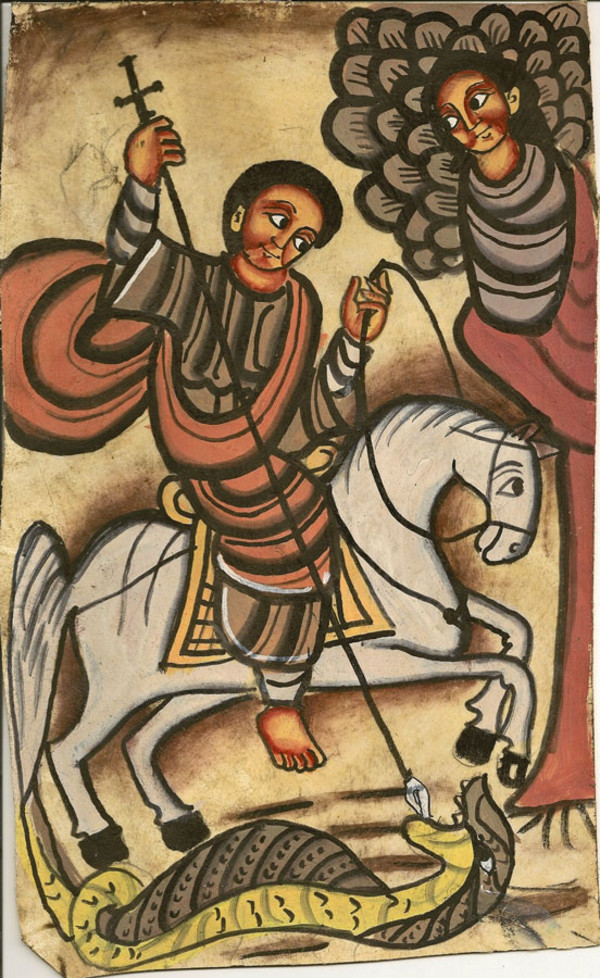
I think of my brothers and sisters, the Christians of the Middle East who live under the threat of persecution, the “daggers of the night.”  Today, we remember Saint George, the patron saint of Ethiopia, among many lands.  I pray for the souls of those 28 Ethiopian men, fellow “people of the Cross” killed by terrorists in Libya this week. 

The legends, as my youngest son can recount in great detail, tell that Saint George killed the dragon, and defended the weak.  What we know more clearly is that he was a fourth century martyr, slain for our common faith.  “Christ my captain,” Saint George prayed, “my Lord I have no strength but what Thou shalt give.  Help me this day and the glory shall be thine forever and ever.” (The Glorious Company, 113)


May Saint George pray for them, and for us.  Christ is our captain, the one who strengthens us to stand firm in the evil day and who protects us through the perils of the night.  We rest in His peace, which is the only true safety.