Showing posts with label Moses. Show all posts

Monday, August 28, 2017

The Man of Pride

“Now there arose a new king over Egypt, who did not know Joseph.”  Exodus 1:8

There are seventeen people named in the first section of the book of Exodus, from which today’s Old Testament lesson is taken. The author of the book, which we will be reading from on Sundays for most of the next three months, does a fine job of setting up his story.  He begins with Jacob, the last of the great patriarchs, who resettled his family in Egypt.  He gives the names of all twelve of his sons, from whom Israel’s tribes are descended.  He recounts the birth of Moses, the eventual hero of the story.  His older sister, Miriam is named, and we’re even introduced to Shiprah and Puah, the midwives who delivered him.  Seventeen people are named, but the narrator can’t quite recall just who was king in Egypt.

 This is certainly intentional, and highly ironical.[1]  Because the king of Egypt—probably the Pharaoh Rameses II—was undoubtedly the most important man in the world at the time.  He held absolute power in the world’s most aggressive state.  He was owner of all property in the world’s wealthiest state.  The art and literature of the world’s most advanced culture celebrated his exploits.  If he was, in fact, Rameses II, he had a harem so large that he left behind at his death a hundred sons and fifty daughters, whose descendants formed a social class, the Ramesids, that dominated Egyptian society for decades after his death.[2]  He was worshipped as a god in life, and a massive monument honored him in death.  His was not a name anyone of his time could forget.  But to the narrator, he is simply “a new king over Egypt, who did not know Joseph.” 

Sunday, August 6, 2017

The Eighth Day of their Lives

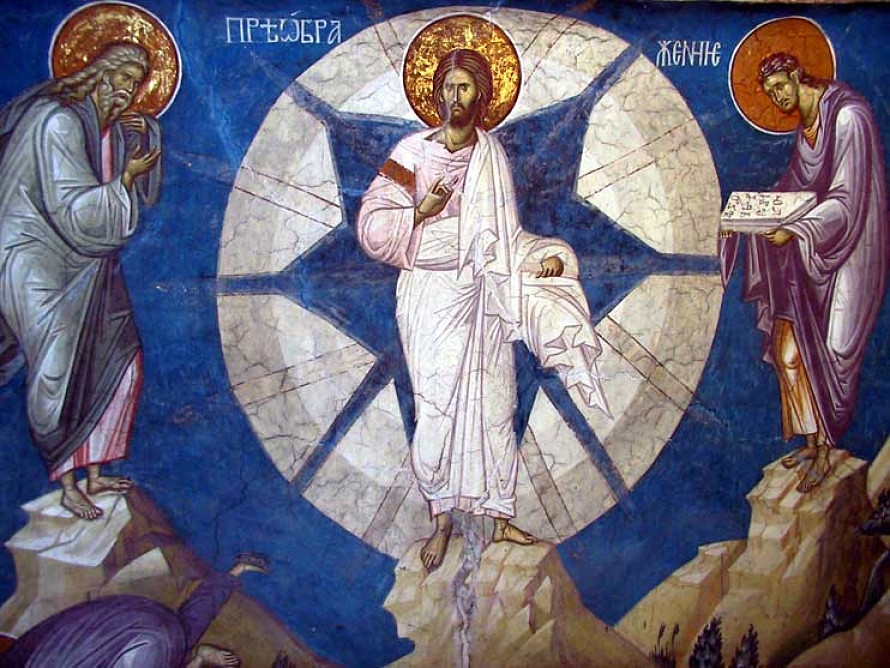
“And behold, two men talked with him, Moses and Elijah, who appeared in glory and spoke of his departure, which he was to accomplish at Jerusalem.”  St. Luke 9:30-31

Over the last few months, I’ve had several conversations with people who are staring down retirement.  Some friends are leaving their work with a deep sense of satisfaction, ready to take on some long-postponed projects.  Others are worried about how they will fill the time and are looking for a way to hang in for a few more years.  One friend was doing the most fruitful and fulfilling work of his career, but the funding ran out, and he’s facing part-time work, something quite different.  It might be marvelous, but I don’t think he’s completely sold on it yet. 

In the back of most of those conversations lay a series of questions I suspect we’ve all asked ourselves, even if retirement lies half a lifetime away: “Does my life add up? Does it have meaning, this work into which I have poured so much of my time and energy?  Do I have a legacy?”  It’s worth reminding ourselves that our privilege allows us to ask these questions of our work.  Most people in history and most people in the world today simply must toil on until their bodies give way.  But for all people, life is unpredictable, full of unexpected shifts, confusing blessings and overwhelming sorrows.  We long to understand where our lives are headed, how their true meaning will be revealed.  But so often, in the end, there is only confusion.  We see ourselves only through clouds of smoke, beset by doubt and fear.